In May 2026 the company IMPOSSIBLE acquired the Rarible brand and core platform assets, while the RARI Foundation and the RARI token stayed with the foundation entities. This article separates the marketplace that changed hands from the token that did not, records that RARI Chain was announced as sunsetting, and gives you a checklist for confirming the contract and the current state yourself.
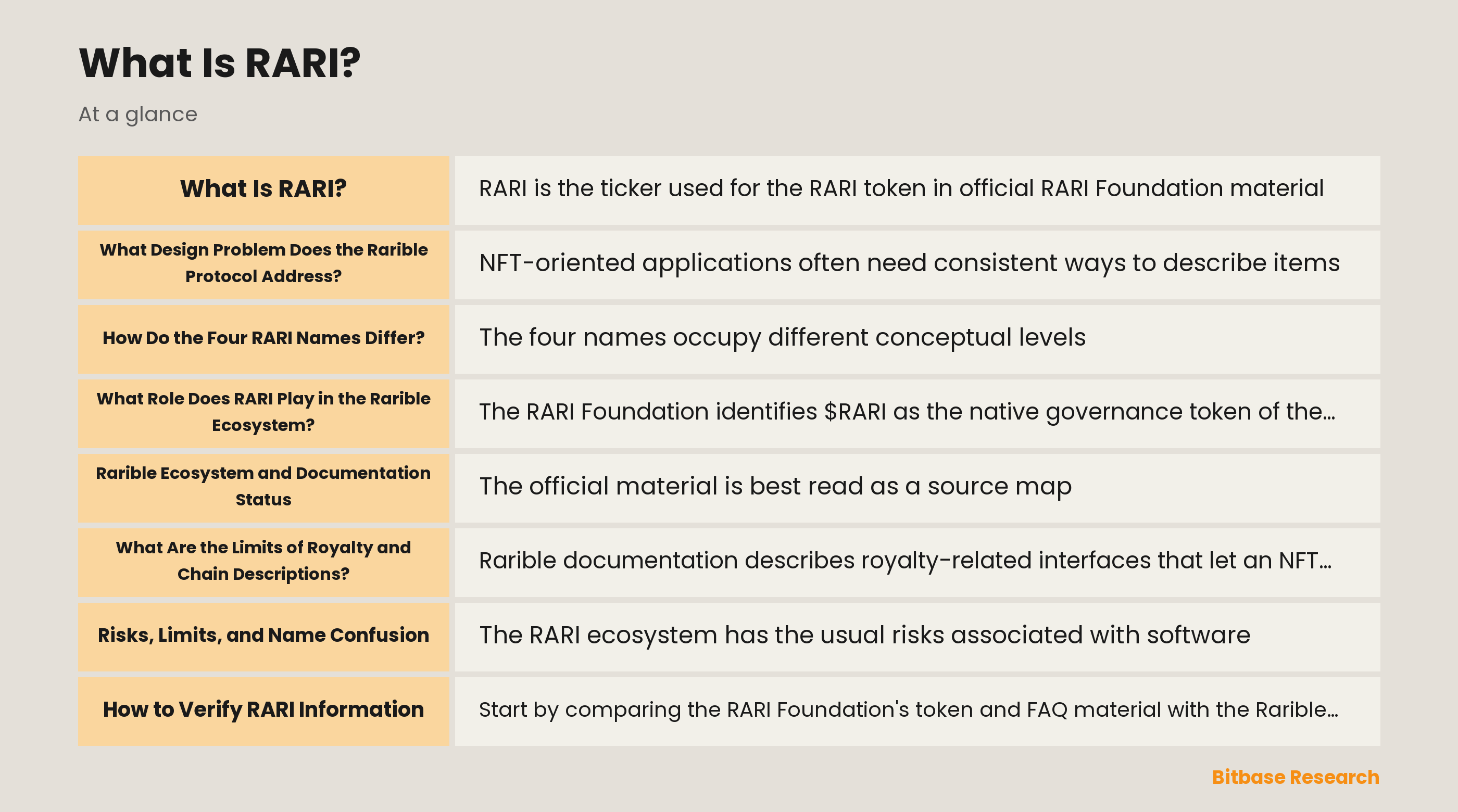
What Is RARI?
RARI is an ERC-20 token on Ethereum, contract 0xFca59Cd816aB1eaD66534D82bc21E7515cE441CF, with a total supply of 25,000,000 and 18 decimals. It began as the governance token of Rarible, an NFT marketplace, and it is administered by the RARI Foundation rather than by the marketplace company.
That last sentence became load-bearing in May 2026. On 29 May 2026 Rarible announced that IMPOSSIBLE had acquired the Rarible brand and core platform assets, including the RaribleX infrastructure business, and reporting of the announcement states that the RARI Foundation ecosystem and RARI tokens remain independently managed by the relevant foundation entities. The marketplace changed owners; the token did not go with it.
Four names therefore have to be kept apart. Rarible is the marketplace and the brand, now owned by IMPOSSIBLE. The RARI Foundation is the entity that administers the token and the DAO. RARI is the ERC-20 token itself. And RARI Chain was a separate Layer 3 network, whose status is covered later in this article and which should not be assumed to be running.
What Problem Does the RARI Design Try to Solve?
The original problem was who captures the value a marketplace creates. An NFT marketplace is a two-sided venue: creators list, collectors buy, and the operator takes a fee. The argument behind a governance token was that the people generating the volume should have a claim on how the venue is run, including fee levels, listing rules and how creator royalties are treated, rather than leaving those decisions entirely to a private company.
RARI was issued to make that claim concrete. Holders could lock the token to gain voting power and route treasury spending through proposals, with the DAO rather than the operating company deciding on incentives. The stated goal was a marketplace whose parameters were set by its participants.
The May 2026 sale is the natural test of that design, and it produced a genuinely unusual outcome rather than a clean success or failure. The commercial engine, meaning the brand, the marketplace and the RaribleX business that earns marketplace fees, moved to a buyer. The governance apparatus, meaning the foundation, the token and the treasury, stayed behind. Whether a governance token retains meaning once the venue it governed belongs to someone else is the open question this article does not answer for you.
How the RARI System Works Today
The marketplace still runs and still has real trading. As of 14 August 2026 rarible.com is live, titled as a multichain NFT marketplace, with a chain switcher offering Ethereum, Solana, MegaETH and Base among others, and with collections showing genuine daily volume and sale counts in the tens of thousands of dollars rather than placeholder figures. It is a working business, now under new ownership.
The token side runs on Tally and on the foundation's own site. RARI is described by the foundation as available on Ethereum, Arbitrum and RARI Chain. Governance participation involves locking or staking the token and delegating voting power, and the foundation publishes a proposal list, including one titled Enable RARI Staking with an allocation of 110,000 RARI, which shows where the rewards come from.
The documentation does not agree with itself, and a reader should know that before relying on any single page. The help centre describes locking RARI to receive veRARI, a voting-escrow position whose benefits are listed as voting power, zero trading fees, private community access and priority status, with a stated minimum lock of 100 RARI, and it mentions no yield at all. The foundation's own homepage instead advertises a staking product on Tally with an advertised rate of up to 70 percent. The foundation's FAQ describes a third arrangement in which staking happens on RARI Chain and yield comes from delegating voting power to active DAO members. These are three different mechanisms described by the same project.
What Role RARI Plays in the Rarible Ecosystem
The documented roles are governance and, depending on which page you read, some form of staking reward. Locking produces voting power and, per the help centre, fee and access benefits on the marketplace. That is the utility set the project publishes, and this article reports it without suggesting you acquire, lock or stake anything.
The distribution is published by the foundation and is the clearest tokenomics fact available: a 25 million total supply allocated as 10 percent airdrop, 30 percent investors and team, 20 percent token incentives and 40 percent DAO treasury. Note what that means in practice. The largest single allocation is the treasury the DAO itself controls, and the second largest belongs to investors and the team.
Where the advertised yield comes from is the part most worth understanding, because it determines whether the rate is sustainable. It is not paid out of marketplace revenue. It is paid by the DAO treasury as an incentive, authorised by governance proposal, to holders who stake and delegate. That is an emission funded by a fixed pool, not a share of a business, and a headline rate on an emission tells you about the size of the incentive programme rather than about the health of the underlying venue. Read any advertised rate as the project's own figure with that mechanism attached.
The Rarible Ecosystem and Adoption Today
The most honest statement of scale is that activity is thin. A third-party security dashboard tracking the project recorded 239 active users and 858 transactions across a seven-day window as of 14 August 2026. Those are small numbers for a project with a marketplace, a foundation and a token, and they are more informative than any headline total.
The treasury figure published on the foundation's own homepage should not be repeated without a caveat, and this is a concrete example of why self-reported dashboards need checking. The site shows a current treasury of roughly 4.9 million US dollars alongside a holding of 3,789,712 RARI. Those two numbers are only consistent at a token price far above where RARI actually trades: at the price recorded by independent trackers on 14 August 2026, the same 3,789,712 RARI is worth a small fraction of the advertised dollar amount. The token count is checkable on chain; the dollar figure on that page is stale. Quote the token count, not the dollar number.
The audit position is also weaker than a badge might imply. The project's page on a well-known security-assessment platform shows zero completed audits, with the project recorded as under review since 19 October 2022 and its status marked as remediating findings, with no completed KYC verification and no bug bounty programme listed through that platform. An entry on an audit platform is not an audit.
How This Split Differs from a Normal Acquisition
In a normal acquisition of a token-adjacent business, the token and the company move together or the token is wound down. Here the operating business and the governance layer were separated: a buyer took the brand, the marketplace and the infrastructure product that earns fees, while the foundation kept the token, the treasury and the DAO machinery. Both halves continue to exist under different owners.
The consequence is worth stating plainly rather than judging. A governance token normally derives its meaning from the thing it governs. When the venue is sold, the token's remaining scope is whatever the foundation itself still controls, which is the treasury and the DAO process. That is a real scope, and it is a smaller one than the token was designed for. This article describes the structure and leaves the assessment to you.
Risks, Limits, and Name Confusion
The chain-status risk comes first because it contradicts what the project's own site still says. RARI Chain was publicly announced as beginning to sunset, with users told to move assets back to Ethereum, and reporting of that announcement describes the move as redirecting resources toward the creator economy. Meanwhile rarichain.org remains online and still states that RARI Chain mainnet is live, with a copyright line dated 2024 and news items from the same year. When this article was written the mainnet block explorer for that chain did not respond, and its recorded value locked had been static since April 2026. This article does not assert that the chain is running, and neither should you until you can see blocks yourself.
The documentation-conflict risk is second and it is not cosmetic. Three official surfaces describe three different staking mechanisms, and one of them locates staking on the chain that is being sunset. When a project's own pages disagree about how its token works, no third-party summary can resolve it, and any number attached to the wrong mechanism is meaningless.
The self-reported-data risk is third, and this project supplies its own example: the treasury dollar figure on the foundation homepage is materially inconsistent with the token count next to it at current prices. Treat every dashboard number on any project site as a claim with a date, and prefer the on-chain quantity to the converted value.
The remaining risks are structural. The brand and the marketplace now belong to a different company, so the token no longer governs the venue that gave it its name. Activity across the token ecosystem is thin, which widens spreads and makes exiting a position harder than a headline supply figure suggests. Advertised yield is treasury-funded emission and can be changed or ended by governance. No completed audit is published through the platform where the project is listed. And RARI is deployed on more than one network, so an address without a chain label identifies nothing. This article makes no claim about how RARI is classified anywhere.
How to Verify RARI Information
Start from a domain you typed. Enter rari.foundation and rarible.com yourself, and reach the governance interface, the help centre and every social account only by following links outward from those pages. Compare each domain character by character, and note that rarichain.org is a separate site that has not been updated. If a page reached from an advertisement or a message asks you to connect a wallet to claim, migrate or verify, close it.
Pin the contract before anything else. The Ethereum contract is 0xFca59Cd816aB1eaD66534D82bc21E7515cE441CF with 18 decimals and a 25,000,000 total supply. Open a block explorer for Ethereum, confirm the name, the symbol, the decimals, that the source is verified, and the holder count. RARI also exists on other networks, so refuse any address that arrives without a network label, and never assume an address valid on one chain is the right asset on another.
Check the chain question yourself rather than trusting any page, including this one. Look for a working block explorer for RARI Chain, check whether new blocks are being produced and at what interval, and check the bridge for any published deadline to move assets back to Ethereum. If the explorer does not respond and the value locked has not moved for months, record that as what you observed, and do not accept a marketing page that says mainnet is live as evidence to the contrary.
Finally, verify the treasury and the yield at the source rather than through the dashboard. The treasury address is on chain, so read the balance there and convert it yourself at a price you can see. For any advertised rate, find the governance proposal that authorised it, read the allocation size, and confirm which mechanism it applies to, since the help centre, the homepage and the FAQ describe three. Where a security platform lists a project as under review with zero completed audits, write down under review rather than audited, and re-check everything on the day you act.
Conclusion
RARI is an ERC-20 token on Ethereum with a 25 million supply, administered by the RARI Foundation. In May 2026 the Rarible brand and core platform assets, including RaribleX, were acquired by IMPOSSIBLE, while the foundation ecosystem and the token remained independently managed. The marketplace still trades under new ownership; the token still governs the foundation and its treasury.
Three things should stay in front of a reader. RARI Chain was announced as sunsetting with users told to bridge assets back to Ethereum, even though rarichain.org still advertises it as live. The project's own pages describe three different staking mechanisms, one of them located on that chain. And the treasury dollar figure published on the foundation homepage is inconsistent with the token count beside it at current prices. Read the token quantity on chain, confirm the contract address on an Ethereum block explorer, and check the chain's explorer for yourself before accepting any claim that it is running.
Related market pages
Bitbase pages for the tokens named in this article:
- RARI: View price
Related reading
Other Bitbase articles on this topic:
- What Is Habbo NFT? A Boundary-Based Guide to Habbo Collectibles
- Nexpace and MapleStory Universe Explained
- Two Models for Football's Web3 Collectibles: Sorare vs. FIFA Collect, Five Years In
Disclaimer: This article is educational content from Bitbase Academy, provided for information only. It explains what a project does and what role its token plays in that system; it does not constitute investment, trading, tax, or financial advice, and it is neither a recommendation nor an endorsement of any project or token. Bitbase has not carried out due diligence on the project described here, and mentioning it does not mean Bitbase lists or supports the asset. Crypto assets carry significant risk, including price volatility, thin liquidity, smart-contract failure, regulatory uncertainty, and the possible loss of their entire value. Written as of August 2026; a project's status, tokenomics, team, and contracts can change at any time. Verify everything yourself through official channels, the contract address, and a block explorer, and beware of imitation sites and phishing links.
References
[1] RARI Foundation official homepage (supply, distribution, treasury widget, staking link) rari.foundation
[2] RARI Foundation FAQ (networks where RARI is available, staking description) rari.foundation
[3] Rarible help centre, What is RARI (veRARI lock mechanics and benefits) help.rarible.com
[4] Rarible marketplace, live collections and volume rarible.com
[5] Ethereum block explorer entry for the RARI ERC-20 contract (supply, decimals, holders) eth.blockscout.com
[6] PANews, Impossible acquires the Rarible brand and core platform assets (29 May 2026) panewslab.com
[7] CertiK Skynet project page for Rarible (audit status, active users, transactions) skynet.certik.com
[8] RARI Chain official site (still advertising mainnet as live, last updated 2024) rarichain.org
[9] L2BEAT project page for RARI Chain (stage assessment and milestones) l2beat.com