Solstice Finance documents a Solana-first product stack that separates USX as a settlement asset, yield-vault tokens such as eUSX, and SLX as the protocol's native token. This neutral profile separates the documented system, its current naming, and the stated role of SLX.
This profile answers the identity and mechanism question first, then keeps the project name, its documented components, and its changing service state separate. The search phrases “solstice tokenomics and use cases”; “what is solstice crypto”; “solstice solana” can describe a reader's lookup intent, but they do not prove a product feature, a current entitlement, or a financial conclusion. The article therefore uses source-scoped language and does not treat a ticker or a user-facing interface as a shortcut for the entire system.
What Is Solstice Finance
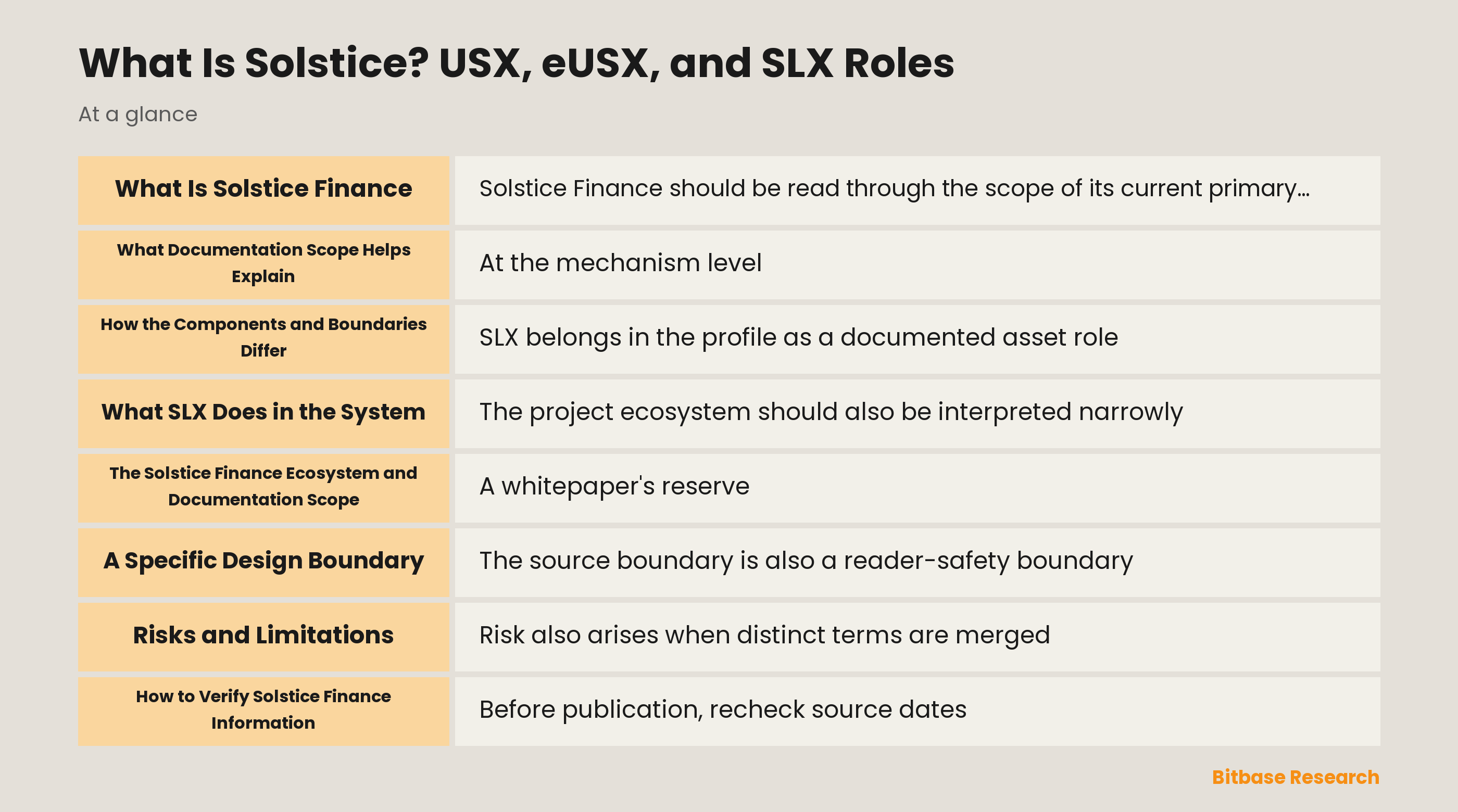
Solstice Finance should be read through the scope of its current primary materials. The whitepaper describes a product stack in which a settlement asset, strategy-specific yield wrappers, a consumer application, and a native-token access layer have separate roles. Explaining those distinctions is more accurate than treating the Solstice name as one asset. That framing avoids a common error in project profiles: using one label for an organization, a protocol, an interface, an asset, and every service that may be associated with them. A careful description names the layer being discussed and does not assume that a statement about one layer automatically proves a statement about another.
Most of the confusion around this project comes from names rather than from mechanisms, and one case of it is unusually literal. The name is not unique: an unrelated project also called Solstice exists in the Filecoin ecosystem, and at least one mainstream page has attached news about that other Solstice to the SLX listing. Inside the documented stack the same problem repeats at a smaller scale, because USX, eUSX, SLX and stSLX are four separate units described by one whitepaper. A sentence about Solstice is therefore only usable once it is anchored to SLX, to USX, or to the solstice.finance domain.
Two identity checks matter before reading anything else about this project. First, the ticker: the asset associated with Solstice Finance is SLX, and the protocol's stablecoin is a separate unit called USX; a page that labels the asset with some other three- or four-letter symbol is describing something else. As of 2026-08-15 the addresses published on token-data pages are SLXdx4BUt2v9uJQNzWqSfzTJ9UKLUDsvxHFMEEdrfgq on Solana and 0x02bcc4c181b83a8c0a342bc003389cbecb4bc54d on BNB Smart Chain, with solstice.finance as the stated website. Second, the name is not unique: an unrelated project also called Solstice exists in the Filecoin ecosystem, and at least one mainstream price page has attached news items about that other Solstice to the SLX listing. Any sentence about "Solstice" is therefore only usable when it is qualified by SLX, USX, or the official domain.
What Documentation Scope Helps Explain
At the mechanism level, USX is presented as the common settlement layer for the documented vault design, while eUSX and other wrappers refer to specific product mechanisms. The same whitepaper describes SLX and a staked representation as a separate access and governance layer. The important point is not a promise about performance; it is the relationship the documents describe between components. Those components can have different update schedules, permissions, technical dependencies, and operational conditions. Explaining the relationship helps a reader see why a product label alone is not enough to determine what a particular record, feature, or asset actually represents.
The documented mechanism also needs a boundary around evidence. Public documentation usually has a publisher, a date, a product version, and a limited subject. It may be changed or superseded. A precise profile can say that a page describes a stated architecture, but it should not silently expand that page into a claim that every related application is live, every integration is current, or every future roadmap item has arrived. Those are distinct claims that need their own current source.
How the Components and Boundaries Differ
SLX belongs in the profile as a documented asset role, not as a verdict about ownership or value. As of 2026-08-15, the whitepaper describes SLX as Solstice Finance's native token. The paper says SLX does not represent equity, debt, ownership, profits, dividends, or a guaranteed financial return, and any role must therefore stay within the document's stated access and governance scope. A ticker is especially weak evidence when similarly named assets, multiple networks, receipt tokens, implementation contracts, or historical deployments exist. The release-day check should compare the project's current official identifier with the relevant official record, retain the network context, and avoid treating a copied symbol as definitive proof.
A useful way to read the asset section is to ask what it does in the documented system, what it does not establish, and which claims remain time-sensitive. A described coordination, access, security, or participation role does not automatically give every holder a product right, a governance result, a distribution right, or a service guarantee. The source may use conditional language, and a neutral profile should preserve that condition rather than replacing it with a stronger statement.
What SLX Does in the System
The project ecosystem should also be interpreted narrowly. A documentation hub can show components, code, environments, providers, or interface categories, but it is not automatically a permanent list of active partners or supported services. The word ecosystem is useful only when it points back to a defined source scope. It should not be used to imply that an organization controls every related application or that every named integration continues without interruption.
USX, eUSX, SLX, stSLX, planned vaults, and the separate governance and management entities named in the whitepaper are not interchangeable. Several products and governance phases are described as active development or forward-looking, so an article must not turn plans into present availability. This distinction matters because product names and protocol names often persist while their interfaces, permissions, contracts, policies, and availability change. A profile that identifies both the current source and its exact claim gives readers a way to revisit the evidence later. A profile that turns a dated page into a permanent assertion gives a false sense of certainty.
Supply is the part of this system a reader can check independently, and it is not settled. As of 2026-08-15 token-data pages record roughly 242.8 million SLX in circulation against a total and maximum supply of 1,000,000,000, so about three quarters of the units that can ever exist are not yet trading. Distribution events are still running: a second SLX unlock was reported to have been followed immediately by selling pressure, and a season-two incentive programme allocated on the order of 3.25% of supply to liquidity farming. There is also a documented dispute about eligibility, with reports that some addresses had airdrop allocations forfeited for failing to meet a total-value-locked threshold. None of this is a judgement about the protocol; it is the mechanical point that a large share of supply is scheduled to arrive later and that the rules governing who receives it have already been contested.
The Solstice Finance Ecosystem and Documentation Scope
A whitepaper's reserve, strategy, audit, capacity, governance, legal-entity, or redemption discussion is evidence only for the dated statement it makes. It does not prove a current asset identifier, ongoing access, a stable outcome, a reserve result, or suitability for a reader. This is why network labels, contracts, mint records, or application URLs are release-day facts rather than evergreen prose. A neutral article can explain the categories involved without asking a reader to take an action. It should record the difference between an official identifier and an operational instruction, and it should not convert a verification principle into a deposit, claim, bridge, staking, or account-management tutorial.
There are technical limits as well as naming limits. Software has implementation assumptions; services depend on infrastructure; contracts can expose administrative controls; and offchain records can have different retention, privacy, and update properties from onchain records. An architecture description is not an audit, and an audit notice is not a blanket security guarantee. These distinctions matter more when a project involves data, identity, delegated execution, authorization material, or a changing token structure.
Two adoption numbers are often quoted together and should not be, because they measure different things. Total value locked, reported by DefiLlama at roughly $506 million on 2026-08-15, counts third-party assets deposited into the protocol; it is not a holder's claim and it is not evidence that the token captures any of it. The project's own second-season programme, which put on the order of 3.25% of SLX supply into liquidity incentives, is a reminder that a deposit figure can be rented rather than earned, and that it can leave when the incentive stops. Trading is also narrow and geographically concentrated: on the same date price aggregation drew on 22 exchanges and 29 markets, with a Korean won pair on Upbit accounting for about a quarter of the 24-hour volume, a second Korean won pair on Bithumb for roughly another 9%, and an OKX dollar-stablecoin pair for about 13%.
A Specific Design Boundary
The source boundary is also a reader-safety boundary, and here it has to cover a name collision as well as an address. The identifiers published on token-data pages are SLXdx4BUt2v9uJQNzWqSfzTJ9UKLUDsvxHFMEEdrfgq on Solana and 0x02bcc4c181b83a8c0a342bc003389cbecb4bc54d on BNB Smart Chain, with solstice.finance given as the website. Because an unrelated Filecoin-ecosystem project shares the name, matching the domain and the address together is what separates the two, and matching on the word alone is what merges them. Each address should be read against the explorer for its own chain, with the date of that reading kept.
Risks include smart-contract and administrative controls, strategy and counterparty dependencies, stable-value and liquidity stress, restricted jurisdictions, changing documentation, future-product uncertainty, and confusion between a settlement asset, a yield wrapper, and a protocol token. These risks do not mean that the documented design is invalid; they mean that a short profile should not overstate what it establishes. The proper conclusion is conditional: documentation supports the mechanism it actually describes, subject to implementation, governance, source freshness, and the surrounding technical and legal context. Readers need more current evidence for claims about access, performance, holdings, allocations, audit coverage, or regional treatment.
Risks and Limitations
Risk also arises when distinct terms are merged. A network is not automatically a wallet, a proof is not automatically raw data, a receipt is not automatically the protocol asset, and a public identifier is not automatically the only valid deployment. Keeping these distinctions visible makes it easier to notice false equivalence, unsupported entitlement claims, and time-sensitive statements. It also makes the article useful without turning it into a comparison, endorsement, or operational guide.
Neutral verification begins with the official project domain and its documentation hierarchy. Check the exact name used by the publisher, the stated role of SLX, and the scope of any current technical or legal notice. If an official page provides a contract address or equivalent identifier, compare the date, network, and label with the corresponding official block explorer record. Do not infer a relationship from a matching ticker, a copied address, or a page whose scope is unrelated to the claim being made.
How to Verify Solstice Finance Information
Before publication, recheck source dates, implementation or upgrade notices, token or mint identifiers, permission descriptions, product naming, and availability statements. Review current official material for audit language, governance wording, supported environments, regional restrictions, and documentation revisions. This second pass is important because an accurate explanation of a design can remain evergreen while identifiers, interfaces, policies, and service conditions change. The profile should be updated or narrowed if the source no longer supports its wording.
Solstice Finance can therefore be introduced as a documented system with distinct layers rather than as a single undifferentiated product. SLX should be described only through its sourced role, and every more specific claim should retain its network, contract, interface, or product context. This explains the project without treating documentation as an offer, a guarantee, or an instruction.
Conclusion
The core interpretive rule is separation. A project label is not every product layer. A token symbol is not every contract or network. A current interface is not a timeless availability statement. A technical description is not a security certification. Once those distinctions are made explicit, the reader can compare sources more carefully and avoid projecting a claim from one category into another.
For a release-ready version, keep the mechanism, asset role, and document boundary in separate sentences. Do not add claims about supply, allocations, audits, governance, partners, legal status, performance, or access unless a fresh official source covers the precise claim. If a statement is conditional or forward-looking in the source, preserve that wording. This approach is deliberately conservative because it is more accurate for systems whose product, network, and token details can change.
In summary, the responsible question is not merely what is Solstice Finance, but what exact layer a source describes, what SLX is documented to do, and which facts still need release-day verification. That approach leaves room for readers to investigate official records while keeping the article educational, neutral, and free of financial conclusions or product-operation instructions.
Related market pages
Bitbase pages for the tokens named in this article:
- SLX: View price · Perpetual market
Related reading
Other Bitbase articles on this topic:
- What Is Spark SPK? Stablecoin Capital Infrastructure
- What Is a Collateralized Stablecoin? Backed by Reserves
Disclaimer: This article is educational content from Bitbase Academy, provided for information only. It explains what a project does and what role its token plays in that system; it does not constitute investment, trading, tax, or financial advice, and it is neither a recommendation nor an endorsement of any project or token. Bitbase has not carried out due diligence on the project described here, and mentioning it does not mean Bitbase lists or supports the asset. Crypto assets carry significant risk, including price volatility, thin liquidity, smart-contract failure, regulatory uncertainty, and the possible loss of their entire value. Written as of August 2026; a project's status, tokenomics, team, and contracts can change at any time. Verify everything yourself through official channels, the contract address, and a block explorer, and beware of imitation sites and phishing links.
References
[1] Solstice Finance website solstice.finance
[2] Solstice Finance May 2026 whitepaper 109607783-files.gitbook.io
[3] Solstice application swap page dapp.solsticelabs.io
[4] Solstice application ecosystem page dapp.solsticelabs.io