STBL is the ecosystem token of a stablecoin-infrastructure protocol of the same name, and it is not that protocol's stablecoin: the dollar unit is called USST and the yield claim is a separate NFT called YLD. This article sets out what each of the three tokens does, which parts of the system are live today, and what the October 2025 depeg, the published audit scope and the trading allegations mean for anyone checking the project.
What Is STBL
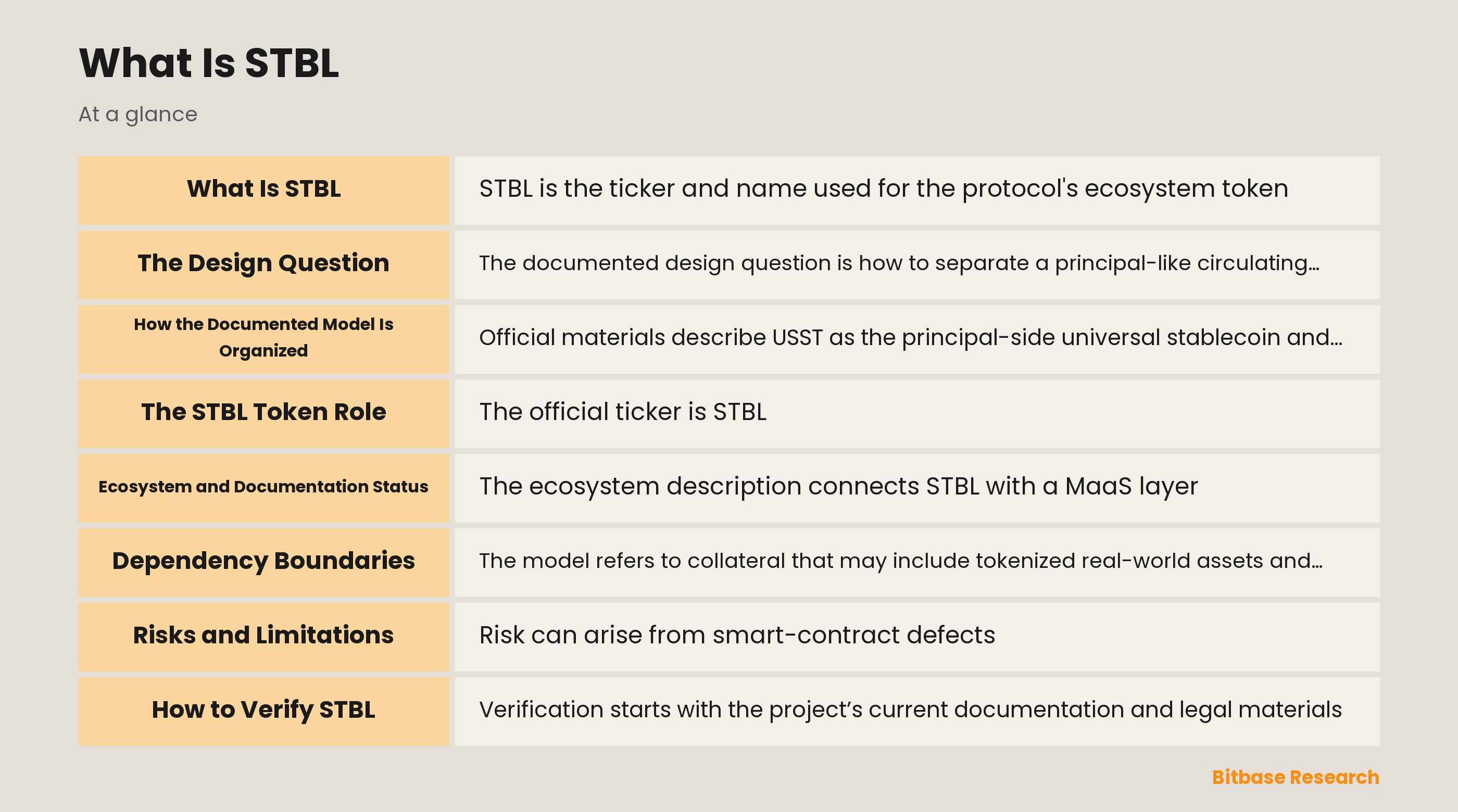
STBL is the name of a protocol, of the company building it, and of one of that protocol's three tokens, which is where most of the confusion starts. The protocol is not a blockchain; it is a set of contracts deployed on other networks, and the documentation lists Ethereum and Stellar as the networks it is currently available on, while the developer page also publishes live contract addresses on BNB Smart Chain. The ticker of the ecosystem token is STBL, the dollar-pegged unit is USST, and the yield instrument is YLD.
The official page titled The Three Tokens gives each one a separate, non-overlapping job. USST is the over-collateralized stablecoin minted when a user deposits approved tokenized real-world assets; the collaterals page names tokenized U.S. Treasury bills and money market funds as the approved category, currently Ondo Finance's USDY and OUSG. YLD is a non-fungible token minted at the same moment, representing the yield produced by that specific collateral, and it doubles as the claim used to redeem the deposit. STBL is described as the ecosystem utility token and is none of those things.
The team is public rather than pseudonymous. STBL was co-founded by Dr. Avtar Sehra, its chief executive, and by Reeve Collins, who co-founded Tether and served as chief executive of the USDT issuer from 2013 to 2015. That is biography, not a warranty. A founder's earlier company tells you nothing about this protocol's collateral, contracts or solvency, and the two projects share no legal entity, no reserves and no audit, so treat it as background only.
What Problem STBL Says It Solves
Before this design, an institution holding a tokenized Treasury fund faced a plain trade-off. Keeping the fund earned the coupon but left the position hard to spend on chain; converting it into a conventional stablecoin bought liquidity but handed the reserve income to the stablecoin issuer, which is how first-generation issuers make money. Inside a single fungible token, nothing separates the dollar you can spend from the interest that the dollar's backing produces.
STBL's stated answer is the principal-yield split: deposit collateral once, receive a spendable dollar unit and a separate transferable claim on the yield, so the depositor keeps the income while the dollar circulates and anchors other ecosystem currencies. That is the project's own framing of its design goal, published on its site and in its documentation. Whether it holds in practice depends on the collateral, the issuers and custodians behind it, the contract logic and the legal terms of each vault, and this article does not treat the claim as settled.
How STBL Works Today
Minting runs through segregated vaults, one per collateral type. A user deposits an approved token, the protocol mints USST worth roughly 97% of the deposited value, retains about 3% inside the vault as a haircut, and issues a YLD NFT that records the position; the documentation puts the resulting collateralization at around 103% with pure money-market assets, which is the project's own figure. Only assets from whitelisted issuers and custodians are accepted, and the docs state that collateral sits in contracts rather than with a central entity.
The live collateral set is small and worth reading literally. The collaterals page lists tokenized U.S. Treasury bills and money market funds as the approved category, names USDY and OUSG, and describes a T-Bills vault holding bills with three- to twelve-month maturities. BlackRock's BUIDL, Centrifuge's JTRSY and Franklin Templeton's BENJI appear under a separate heading marked Upcoming Collaterals, so they are announced intentions rather than current backing.
The peg is defended by fees rather than by an issuer's redemption desk. The documented Tri-Factor Stabilization Mechanism has a controller read a price signal, in the audited implementation a Curve pool oracle, then raise minting fees and cut burn fees when USST trades below a dollar and do the reverse above it; market makers the docs call Converters are expected to arbitrage that spread, and holders meeting vault criteria can redeem the underlying collateral. The documentation describes that third pillar as being expanded from partial redemption via YLD into full Universal Redemption, so read it as work in progress.
What the STBL Token Does in the System
The token's own documentation is unusually explicit about how little of it is switched on. The STBL Token Utility page lists planned, generic applications: access to product features inside USST and ecosystem-specific stablecoins, incentives for users of integrated lending and borrowing protocols, preferential rates for holders above some balance, and burn-for-reward mechanics. It then states that precise parameters such as holding thresholds or exact burning mechanisms are not currently active and will be announced as individual integrations deploy. STBL is not the gas token of any chain.
What does exist today is staking. Multi-Factor Staking lets a holder lock STBL for a chosen duration and optionally co-lock USST in the same position, with reward weight depending on duration and on that co-lock rather than on size alone; the documentation marks MFS 2.0 as the current version and points to the protocol's own application. Reward rates are not reproduced here, because they are operator-set parameters that can change.
Supply is capped and published; the unlock calendar is not. The tokenomics page puts maximum supply at 10,000,000,000 STBL, expects roughly 700,000,000 in circulation at the token generation event, or 7%, and allocates 40% to treasury and ecosystem development, 20% to staking and incentives, 18% to core contributors and advisors, 10% to liquidity and market operations, 8% to strategic and private allocations, and 4% to community distribution. The same page says detailed vesting schedules will be shared separately, so those percentages currently come without dates.
STBL Ecosystem and Adoption Today
Read every adoption figure in this section as somebody's dated announcement. The documentation says STBL is currently available on Ethereum and Stellar and describes Solana as an upcoming addition, while the developer page also publishes deployed contract addresses on BNB Smart Chain. The list of infrastructure partners naming Chainlink, Fireblocks, Ondo Finance, Redstone, Wormhole and others is the project's own description of its suppliers, not confirmation from those firms.
The clearest dated expansion is Stellar. On 1 July 2026, through a partnership with the Stellar Development Foundation, STBL announced that USST was live on the Stellar network, with initial minting running on eligible tokenized treasury collateral starting with USDY, and Franklin Templeton's BENJI named as a planned second option with no launch date attached; the company did not disclose initial minting volume on that network. The Stellar contract identifiers for USST, YLD, the register and the core contract are published in the developer documentation.
The earlier milestones arrived with counterparty announcements too. On the day USST went live in October 2025, STBL and Ondo Finance announced that up to 50 million dollars of USST minting would be backed by USDY, a figure that came from a press release rather than from an audited statement. If a named integration matters to your assessment, confirm it in that counterparty's own newsroom before relying on it.
How STBL Differs from Other Stablecoin Designs
The first difference is instrumental. Most collateralized stablecoins issue one fungible token and keep the reserve income at the issuer, whereas STBL issues two instruments and routes the income to whoever holds the non-fungible one. Because YLD is also the ticket used to redeem the underlying collateral, transferring it moves both the income stream and the redemption right, which is a different property from an interest-bearing stablecoin where both stay attached to the same balance.
The second difference is how par is defended. A fiat-backed issuer holds the peg by minting and redeeming at a fixed price for approved counterparties; STBL moves mint and burn fees algorithmically against a market price feed and relies on arbitrageurs to close the gap. Those are different trust assumptions with different failure surfaces, one depending on an issuer's banking and redemption capacity and the other on oracle quality, fee parameters and active market makers, and neither is ranked here.
Risks and Limitations
The peg has already broken once in public. USST launched on Curve on 10 October 2025 and slipped below a dollar within hours, reaching as low as $0.96; data cited by The Defiant that day showed roughly $965,000 of liquidity in the pool and 52 holders of the token. Market participants quoted in that report read the move as a liquidity-calibration issue rather than a structural failure, but that attribution is a third-party judgement by commentators, not a finding by the protocol, an auditor or a regulator, and no independent post-mortem establishing the cause was found.
The trading allegations of the same month need the same care. In October 2025 the analytics firm Bubblemaps flagged five interconnected addresses that had sold their entire STBL holdings for a reported profit of about $17 million, which prompted public accusations that they belonged to insiders; Bubblemaps itself then clarified that the wallets had no connection to the STBL team or insiders, and founder Avtar Sehra rejected the accusation, saying the addresses had been active long before the launch. No court or regulator has found otherwise. The token fell steeply over the following weeks, which is context for the episode rather than evidence about it.
Audits exist, but they are commit-pinned and partial, which is why this article carries the unaudited warning. The site publishes two Cyfrin reports: the STBL Audit Report dated 10 September 2025, covering an enumerated list of Ethereum issuer, vault, oracle, yield-distributor, USST and YLD contracts at a single commit; and the STBL Peg Mechanism Audit Report dated 13 December 2025, covering the peg controller, rate calculator, oracle, YLD splitter and the DPT and DLT asset contracts, with 27 issues found including 2 critical and 5 high. Cyfrin's own recommendation in the second report is that a further audit be conducted before significant capital is deployed, and contracts the docs list as deployed, including the BNB Smart Chain ones, do not appear in either published scope.
The remaining risks are structural and unresolved by any of that. Administrative roles in the audited code can burn bridged tokens, disable assets and withdraw funds in an emergency, so the system is not trust-free; the collateral is issued and custodied by third parties whose own failure would pass straight through to holders; the STBL token's documented utilities are not active yet and the redemption pillar is still being expanded, which is what early stage means here; and rules for tokenized funds and dollar-referenced tokens differ by jurisdiction and can restrict who may mint, redeem or hold. This article makes no claim about how STBL or USST is classified anywhere.
How to Verify STBL
Start from the domain, not from the search box. Type the official site and documentation addresses yourself, and use the official site as the origin for every other link, including social accounts, because only the direction from the official domain outward is evidence. Compare whatever domain you land on character by character against the one you typed, and stop if a page reached from an advertisement or a message asks you to connect a wallet in order to claim, migrate or verify anything.
Then pin the contract for your network, because an address quoted without its network is not an answer. The developer page lists them per chain: on Ethereum the STBL token is 0xB3116013C55D49f575ace3cb0d123f3dbF6caC35 and USST is 0xf9d82660828d8f5d121b14a9dc9c677d91f60065, on BNB Smart Chain the STBL token is 0x8dEdf84656fa932157e27C060D8613824e7979e3, and the Stellar deployment uses contract identifiers in an entirely different format. Take each one to the block explorer for that exact chain and confirm the name, the symbol, that the source code is verified, the deployment age, the holder count, and above all that the chain matches the one you were reading about.
Grade the audits and the supply separately. For each report, note the auditing firm, the date, the commit and the list of files in scope, then check whether the address you just looked up is actually inside that list; a report hosted only on the project's own site is weaker evidence than the same report on the auditing firm's site. For supply, circulation and unlocks, read the chain together with the official tokenomics page rather than a price aggregator, since aggregator entries are derived numbers that different sites have not always agreed on.
Finally, keep the three tokens apart while you read. Check that a statement about collateral, reserves or redemption is a statement about USST, that a statement about yield is a statement about YLD, and that a statement about access, staking or incentives is a statement about STBL. Where the documentation says planned, upcoming or being expanded, carry that label into your notes instead of reading it as a live feature, and record which first-party document each claim came from.
Conclusion
STBL is the ecosystem token of a protocol that mints an over-collateralized dollar unit, USST, against tokenized Treasury bills and money market funds, and issues the yield from that collateral as a separate NFT called YLD. The token itself buys access, staking weight in Multi-Factor Staking and incentives that the documentation still describes as largely planned; it is not a claim on the collateral or on its income. The record so far includes a same-day depeg to $0.96 in October 2025, a wallet controversy that the analytics firm behind it later said did not involve the team, and two commit-pinned audits whose scope does not cover everything now deployed. Take the contract address for your network from the official documentation, confirm it on that chain's explorer, and read the audit scope before relying on any of it.
Related market pages
Bitbase pages for the tokens named in this article:
- STBL: View price · Perpetual market
Related reading
Other Bitbase articles on this topic:
- Can a Stablecoin Be Frozen? Blacklists and Issuer Controls
- Stablecoin Settlement Rails: How Dollars Move Onchain
Disclaimer: This article is educational content from Bitbase Academy, provided for information only. It explains what a project does and what role its token plays in that system; it does not constitute investment, trading, tax, or financial advice, and it is neither a recommendation nor an endorsement of any project or token. Bitbase has not carried out due diligence on the project described here, and mentioning it does not mean Bitbase lists or supports the asset. Crypto assets carry significant risk, including price volatility, thin liquidity, smart-contract failure, regulatory uncertainty, and the possible loss of their entire value. This project is at an early stage, and early-stage projects carry a higher risk of failing outright. Its contracts have not been publicly audited, or the published audit covers only part of the code. Written as of August 2026; a project's status, tokenomics, team, and contracts can change at any time. Verify everything yourself through official channels, the contract address, and a block explorer, and beware of imitation sites and phishing links.
References
[1] STBL Docs, The Three Tokens (roles of USST, YLD and STBL) docs.stbl.com
[2] STBL Docs, Collaterals (approved tokenized T-bills and money market funds, haircut and collateralization) docs.stbl.com
[3] STBL Docs, STBL Token Utility (planned utilities, parameters not currently active) docs.stbl.com
[4] STBL Docs, Tokenomics (10 billion cap, TGE circulating share, allocation table) docs.stbl.com
[5] Bitcoin.com News, 1 July 2026: STBL launches USST on Stellar with the Stellar Development Foundation news.bitcoin.com
[6] STBL Docs, Developer Overview (deployed contract addresses on Ethereum, BNB Smart Chain and Stellar) docs.stbl.com
[7] Cyfrin, STBL Audit Report, version 2.0, 10 September 2025 (Ethereum contract scope) cdn.stbl.com
[8] Cyfrin, STBL Peg Mechanism Audit Report, version 2.0, 13 December 2025 (peg controller and DPT/DLT scope) cdn.stbl.com
[9] The Defiant, 10 October 2025: USST depegs to $0.96 hours after its Curve launch, with pool liquidity and holder count thedefiant.io
[10] PANews, 21 October 2025: STBL founder's response and Bubblemaps clarification that the five wallets are not linked to the team panewslab.com