Stellar is a public, open-source layer-1 blockchain built for issuing assets and settling payments in them, and its native asset is the lumen, ticker XLM. This article separates three things often blurred together — the Stellar network, the Stellar Development Foundation and XLM — explains what anchors, SEP standards and Soroban contracts each do, and sets out what to check independently.
What Is Stellar?
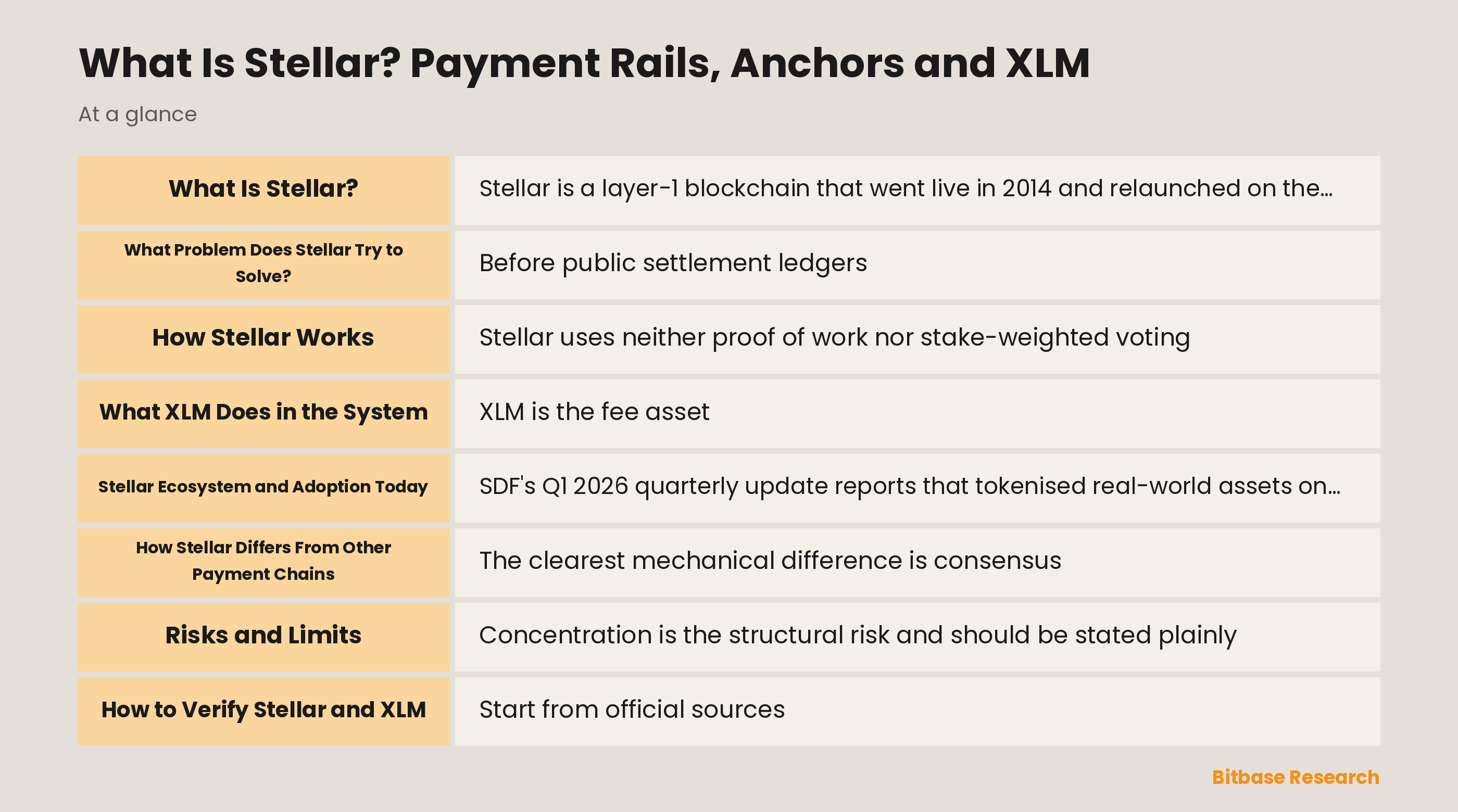
Stellar is a layer-1 blockchain that went live in 2014 and relaunched on the Stellar Consensus Protocol in 2015. It is built around a narrow job: issuing tokenised assets such as fiat-backed stablecoins and tokenised funds, and settling payments in them quickly and cheaply. Its native asset is the lumen, ticker XLM, which per Stellar's developer documentation is the only asset requiring no issuer and no trustline.
Three distinct things carry the Stellar name. The Stellar network is the protocol and the ledger, run by independent validators. The Stellar Development Foundation, or SDF, is a separate legal entity: a non-profit founded in 2014 that describes itself as self-funded, tax-paying and without shareholders, and that writes software, publishes standards and funds ecosystem work. XLM is the native asset. SDF is the largest contributor to Stellar, but it is not the network, and holding XLM is not a claim on SDF.
What Problem Does Stellar Try to Solve?
Before public settlement ledgers, moving value across borders meant chaining together correspondent banks, each with its own cut-off times, reconciliation files and deductions, and each holding a payment while it checked the leg before it. A transfer could take days, its final cost was often unknowable when sent, and no party could verify the leg upstream.
Stellar's stated proposition — the project's own framing, not a verified outcome — is that a shared public ledger compresses that chain: any account can issue an asset, any other account can hold it once it opens a trustline, and settlement happens in seconds against one ledger everyone reads. What the project does not claim is that this removes regulated institutions from the edges. Moving fiat on and off the ledger still needs a licensed business, which is the role the anchor model formalises.
How Stellar Works
Stellar uses neither proof of work nor stake-weighted voting. It runs on the Stellar Consensus Protocol, a federated Byzantine agreement model in which every validator publishes the set of other validators it trusts, and agreement emerges from the overlap of those declared quorum sets. Validators are therefore known, named participants with public trust relationships rather than anonymous stake. SDF treats that as the reason certain governance mechanisms are possible on Stellar.
Three layers sit above consensus and are constantly conflated. Anchors are the on- and off-ramps: per Stellar's developer documentation, an anchor is a financial institution or fintech that accepts a deposit through an existing rail such as a bank transfer and issues the user the equivalent token on Stellar, or redeems tokens back into the asset they represent. Anchors are businesses, subject to the licensing and solvency of whoever runs them.
SEPs, or Stellar Ecosystem Proposals, are the second layer: open-source interoperability standards in a public GitHub repository defining how anchors, issuers and wallets talk to each other. SEP-6 and SEP-24 cover deposit and withdrawal, SEP-10 authentication, SEP-12 a KYC API, SEP-31 cross-border payments, SEP-1 the stellar.toml file where an organisation publishes what it issues. SEPs are not core protocol changes; those travel as Core Advancement Proposals, or CAPs. Soroban is the third layer: Stellar's smart-contract environment, where contracts are written in Rust, compiled to WebAssembly, deployed with a contract ID, and charged rent to keep data on the ledger.
What XLM Does in the System
XLM is the fee asset. Every Stellar transaction pays a fee in lumens, which prices ledger space and orders transactions during surge pricing; smart-contract transactions pay an inclusion fee plus resource fees, including rent for contract state. XLM also underwrites the account model: an account must hold a minimum balance in base reserves, currently 0.5 XLM each, with a floor of two reserves and one more per subentry such as a trustline, offer or signer.
Supply works unlike a mined chain. Per Stellar's developer documentation, every lumen that will ever exist was created when the network went live, an original supply of 100 billion. A 1% annual inflation mechanism was ended by validator vote on 28 October 2019. In November 2019 SDF sent 55,442,095,285.7418 lumens to an address with no signers, permanently removing them; the same documentation puts total supply afterwards at roughly 50.0 billion XLM.
XLM is not a governance token in the token-vote sense. Protocol changes are decided by validators voting on upgrades, not by lumen holders casting weighted ballots, and the documentation describes no staking yield, no fee-burn mechanism and no buyback at protocol level. Its documented roles are transaction fees, account reserves, contract rent, and use as a bridge asset in path payments.
Stellar Ecosystem and Adoption Today
SDF's Q1 2026 quarterly update reports that tokenised real-world assets on Stellar crossed 2 billion US dollars shortly after quarter-end, up from 785 million at the end of 2025, and that stablecoin payment volume reached 5.5 billion dollars in the quarter, up 72% year over year. It also reports 22.5 billion cumulative operations, 10.6 million unique addresses, 86% year-over-year developer growth attributed to Electric Capital, and 13% more validator nodes. All these figures are self-reported by SDF and none is independently audited; treat them as the foundation's own accounting and re-pull the current report before relying on them.
Named participants in that update include U.S. Bank, Amundi, Societe Generale, AllUnity, Kenanga, Franklin Templeton's BENJI and MoneyGram. Those are institutional names in a foundation report, not evidence about product volume; each institution's own disclosure is what to read before concluding anything about scale. The anchor side is more directly checkable: SDF maintains a public anchor directory, and each anchor's SEP-1 stellar.toml states which assets it issues and from which domain.
The structural point is that adoption here is intermediated: tokenised balances and stablecoin volume exist on Stellar because regulated issuers chose to put them there, which couples network usage to those issuers' regulatory standing and commercial decisions rather than to the protocol.
How Stellar Differs From Other Payment Chains
The clearest mechanical difference is consensus. Most public chains select block producers by stake weight or hash power and treat validator identity as irrelevant. Stellar's federated agreement requires each validator to declare whom it trusts, so the validator set is a named, published social graph, and the security argument rests on the overlap of quorum sets rather than on the cost of acquiring stake.
The second difference is that asset issuance and an order book are protocol features rather than deployed contracts. Any account can issue an asset with a classic operation, holders opt in through a trustline, and the Stellar decentralised exchange and its liquidity pools live in the core ledger. Soroban added a contract layer later, so both models coexist on one ledger — which is why a reader must establish which layer a product uses.
Risks and Limits
Concentration is the structural risk and should be stated plainly. SDF is a non-profit, but it holds a very large quantity of XLM. The official Stellar dashboard supply endpoint, timestamped 29 July 2026, put the SDF Mandate at about 15.5 billion XLM against a total supply of about 50.0 billion — roughly 31% of all lumens — held across four disclosed buckets SDF sells from under its published mandate. That figure moves continuously and should be re-pulled from the official endpoint and the mandate page when you read this. The shape of the risk does not: one entity's decisions affect the float.
Governance carries a second risk that sits uncomfortably beside the usual story about ledgers nobody can touch. Protocol 26, codenamed Yardstick, whose stable releases were published on 8 April 2026 and whose mainnet upgrade vote was set for 6 May 2026, introduced CAP-77 Quorum Freeze. Per SDF's own description, it lets a quorum of validators reach consensus on freezing specific accounts, contract data or asset balances directly on-chain: Soroban transactions touching a frozen key are rejected and affected classic offers leave the order book. SDF frames it as auditable, reversible and proportionate. It is also, factually, a live mechanism by which validators can freeze assets. Both are true at once, and finality on Stellar is bounded by it.
Protocol 25, codenamed X-Ray, whose mainnet vote was set for 22 January 2026, added native BN254 and Poseidon primitives — building blocks for zero-knowledge applications, not a privacy feature end users get by default. SDF's Quantum Preparedness Plan, published in June 2026, is a three-stage plan and not a completed migration: stage one adds post-quantum signature verification to Soroban during 2026, stage two proposes quantum-safe signer types for classic accounts in 2027, and stage three, retiring Ed25519, has no date. Until then, Stellar accounts rest on the same elliptic-curve cryptography as most chains. Anchors can fail or lose a licence, issuers carry counterparty and custody risk, Soroban contracts can contain defects, and adoption figures can reverse.
How to Verify Stellar and XLM
Start from official sources, not a search result. Open stellar.org and developers.stellar.org directly and confirm that any documentation site or social account you were pointed to is linked from there; a page linking back to the official site proves nothing. Where an asset is involved, read the issuer's stellar.toml published under SEP-1, or the anchor directory, to see which entity issues it and from which domain. Stop if a domain differs by even one character, if you arrived through a paid search placement, or if anything invites you to connect a wallet.
Then understand what you are checking. XLM is the Stellar network's native asset, not a token contract: it has no issuer account and no contract address on Stellar, so any page advertising an XLM contract address on Ethereum, BNB Chain or elsewhere is describing a wrapped or imitation token on a different chain, not the lumen. Soroban contracts do have contract IDs, so whenever you are handed an identifier, ask first which network and which layer it belongs to.
Check on-chain rather than on an aggregator. Public block explorers for Stellar such as stellar.expert, alongside Stellar Lab and the SDF dashboard listed in the official documentation, let you look up an account, an asset, an issuer and a contract ID and read the ledger history behind a claim. Use them to confirm supply against the network's own dashboard endpoint instead of a third-party listing, to inspect the SDF mandate accounts, and to check when an issuer's account was created. Where a project claims an audit, the report should be findable on the auditor's site. Bitbase has not verified any of this for you.
Conclusion
Stellar is a payment- and issuance-focused layer-1 whose distinctive parts are federated consensus, protocol-level asset issuance and an order book, an anchor model for fiat ramps, SEP interoperability standards, and a newer Soroban contract layer. XLM pays transaction fees, funds account reserves and contract rent, and acts as a bridge asset; it confers no governance vote and no entitlement to yield.
Two things are worth carrying away. SDF is a separate non-profit holding a large share of the lumen supply, a concentration risk regardless of how those funds are spent. And Protocol 26's CAP-77 Quorum Freeze gives a validator quorum a live, on-chain mechanism to freeze assets, which belongs in any honest description of the network. Before acting on any figure here, re-pull the current quarterly report and the live supply endpoint, and read the official documentation, not a summary of it.
Related market pages
Bitbase pages for the tokens named in this article:
- XLM: View price · Spot market · Perpetual market
Related reading
Other Bitbase articles on this topic:
- What Is Rizenet? T-RIZE, RIZE, and Tokenization Boundaries
- What Is Stronghold SHX? A Payments Ecosystem Profile
- Tokenized Securities and Funds
Disclaimer: This article is educational content from Bitbase Academy, provided for information only. It explains what a project does and what role its token plays in that system; it does not constitute investment, trading, tax, or financial advice, and it is neither a recommendation nor an endorsement of any project or token. Bitbase has not carried out due diligence on the project described here, and mentioning it does not mean Bitbase lists or supports the asset. Crypto assets carry significant risk, including price volatility, thin liquidity, smart-contract failure, regulatory uncertainty, and the possible loss of their entire value. Written as of August 2026; a project's status, tokenomics, team, and contracts can change at any time. Verify everything yourself through official channels, the contract address, and a block explorer, and beware of imitation sites and phishing links.
References
[1] Stellar Yardstick, Protocol 26 upgrade guide (Stellar Development Foundation, official blog) stellar.org
[2] Quorum Freeze (CAP-77): A Governed, Onchain Incident Response on Stellar (SDF, official blog) stellar.org
[3] Announcing Stellar X-Ray, Protocol 25 (SDF, official blog) stellar.org
[4] Introducing the Quantum Preparedness Plan (SDF, official blog) stellar.org
[5] Q1 2026: Execution at network scale (SDF quarterly update, self-reported figures) stellar.org
[6] Lumens (XLM) including supply metrics (Stellar official developer documentation) developers.stellar.org
[7] Anchors: on and off ramps (Stellar official developer documentation) developers.stellar.org
[8] Stellar Ecosystem Proposals (SEPs) (Stellar official developer documentation) developers.stellar.org
[9] SDF mandate and disclosed XLM accounts (Stellar Development Foundation, official page) stellar.org
[10] Live lumen supply endpoint, snapshot timestamped 29 July 2026 (SDF official dashboard API) dashboard.stellar.org
[11] stbl launches usst stablecoin on stellar as institutions chase real world asset liquidity news.bitcoin.com
[12] contract development developers.stellar.org