The Graph is a decentralised protocol that indexes blockchain data and serves it to applications as queries, and GRT is the token used to stake, pay and signal inside it. This article explains how Subgraphs work, what the Horizon upgrade changed, what each participant role does, and which claims a reader should re-check at the official source.
What Is The Graph?
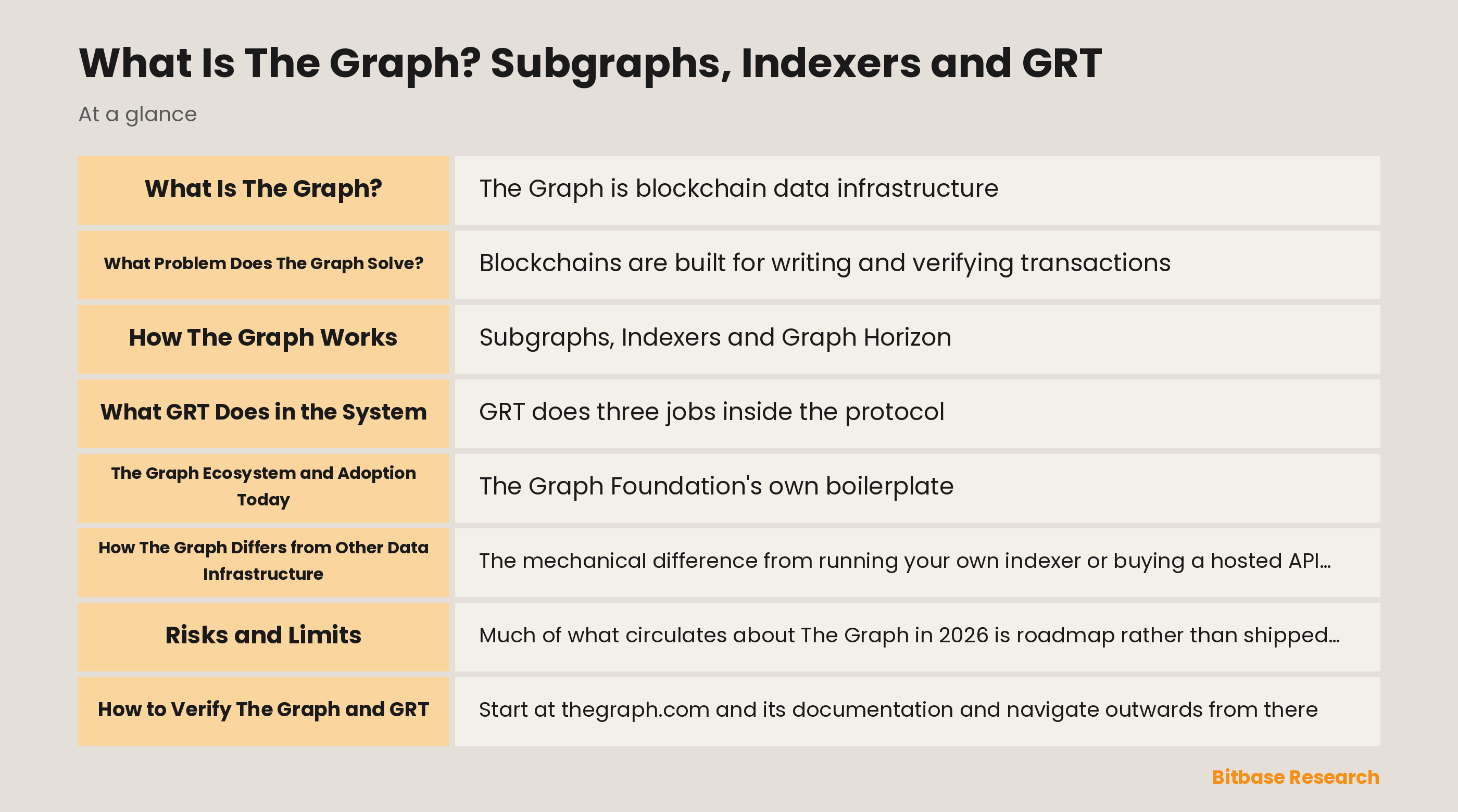
The Graph is blockchain data infrastructure: software plus an on-chain protocol that read raw chain data, organise it, and serve it back to applications as structured queries. The decentralised network launched in 2020, and its principal deployment now runs on Arbitrum One; the official documentation states the protocol was first deployed on Ethereum mainnet and later moved to Arbitrum to lower gas costs. The network token is GRT.
Several distinct entities share the name, and they are not interchangeable. The Graph is the protocol, governed by The Graph Council. The Graph Foundation publishes the official site, documentation and blog. Core development is carried out by separate organisations, including Edge & Node, Semiotic Labs and GraphOps, which post their own progress reports to the community forum. The Graph is not a Layer 1 chain of its own.
What Problem Does The Graph Solve?
Blockchains are built for writing and verifying transactions, not for reading them back. The official documentation lists why: chain data has no relational structure and no query language, contract state sits in low-level storage slots and event logs, historical queries need expensive archive nodes, and a real application scatters data across contracts never designed to be joined. Before shared indexing, every team built and ran that pipeline itself.
The project's argument is that indexing should be shared infrastructure rather than private plumbing duplicated by every team, and that a market of independent operators paid in one token can serve the data without a single point of failure. That is the project's own framing of the problem it addresses. Whether a given application actually gains availability from it depends on how many Indexers serve that specific Subgraph.
How The Graph Works: Subgraphs, Indexers and Graph Horizon
A Subgraph is a developer-written definition of what to index: which contracts and events to watch, which entities to build, and how to transform raw logs into records. Software called graph-node executes that definition, keeps a database in sync with the chain, and exposes the result over a GraphQL endpoint. Published Subgraphs live on The Graph Network on Arbitrum and can index any supported network.
Horizon is the upgrade that turned The Graph from a single-purpose Subgraph indexing service into a modular multi-service protocol. It extracts three reusable primitives — a core staking protocol providing economic security, a unified payments protocol handling fees, and a Data Service Framework for building new services on top — so that different data services share one pool of staked GRT, one payment system and one security model. Core development team Edge & Node reported Horizon's production deployment in December 2025, with over 95% of query volume and Indexer stake migrated. The gateway now serves queries only against TAPv2 receipts, so an Indexer that has not upgraded receives none.
The Subgraph Service is the first and, per the documentation, currently the only data service implementation. The Graph's published 2026 technical roadmap lists a Horizon-based Subgraph Service mainnet rollout under Q1 2026. That is the official schedule; as of August 2026 this article could not find an official confirmation that the mainnet rollout is complete, so it should be read as a schedule and not as a finished item. Later roadmap entries are likewise scheduled, not delivered.
What GRT Does in the System
GRT does three jobs inside the protocol: it is staked as economic security, spent as payment for queries, and signalled to steer where indexing work goes. The documentation puts indexing rewards at 3% annual protocol-wide issuance, query fees are paid in GRT through the gateway, and part of the GRT flowing through curation is burned. It is not gas for a chain of its own.
Indexers are the node operators. They stake GRT — the documented minimum is 100,000 GRT — and under Horizon must explicitly provision that stake to a chosen data service before allocating it to individual Subgraphs. They earn query fee rebates and indexing rewards, and their stake can be slashed for serving incorrect data or indexing incorrectly; Horizon lets arbitrators set the slash amount up to a cap of 10% of stake, with a recommended value of 2.5%.
Curators signal GRT on Subgraphs they consider worth indexing. Signalling deposits GRT into a bonding curve and mints Graph Curation Shares, with a 1% curation tax burned on the way in. Signal matters mechanically because indexing rewards are distributed across Subgraphs in proportion to the curation signal on each. Shares are not traded on an order book: they are minted and burned along that curve, so what burning returns is set by the curve.
Delegators stake GRT to an Indexer without running infrastructure themselves, and share in that Indexer's rewards according to the queryFeeCut and indexingRewardCut the Indexer sets. Horizon changed three things here: delegation is now per data service, so a Delegator picks both an Indexer and a service; the 0.5% delegation tax was removed; and up to 100 undelegation requests can process at once. Delegation is not slashable today, but the documentation says the capability now exists.
Developers and data consumers are the demand side. They write and publish Subgraphs and pay for queries in GRT through the gateway's billing system, which accepts GRT on Arbitrum One. The documentation states that Subgraph behaviour, schemas, curation signal and APIs are unchanged for them after Horizon; what changes is that additional data services can be paid for through the same protocol rather than through separate vendors.
The Graph Ecosystem and Adoption Today
The Graph Foundation's own boilerplate, repeated in its documentation and blog posts, describes the network as covering 60+ networks and states that, as of early 2026, it had served over 1.27 trillion queries to more than 75,000 projects, powered by 50+ independent Indexer nodes. Those are project-reported figures with an early-2026 cut-off, not third-party audited counts, and they should be re-fetched from the official site rather than quoted from here.
The product line published alongside Subgraphs includes Substreams for parallel streaming, a Token API documented as covering ten chains, and Amp for SQL-style, audit-oriented access. The Hosted Service that predated the decentralised network has been retired: the official FAQ states the Sunrise of Decentralized Data ended on 12 June 2024, that hosted service query endpoints are no longer available, and that new subgraphs cannot be deployed there. The Foundation also reports GRT bridged to Arbitrum, Base and Avalanche via Chainlink's CCIP.
How The Graph Differs from Other Data Infrastructure
The mechanical difference from running your own indexer or buying a hosted API is where the guarantees come from. In this design the operator serving a query has GRT staked that can be slashed for serving incorrect data, several independent Indexers can serve the same Subgraph, and which Subgraphs earn indexing rewards is decided by curation signal rather than by a vendor's product plan. That is a different failure profile, not a claim about speed.
The second mechanical difference is structural. Many data protocols bind staking, payments and their single service tightly together. Horizon separates them: staking and payments are protocol primitives, and a data service is a module registered on top, with its own parameters and governance. That is why an Indexer must provision stake per service and a Delegator must pick a service — an operational step that single-service designs do not require.
Risks and Limits
Much of what circulates about The Graph in 2026 is roadmap rather than shipped code. The Foundation's own roadmap page carries a note that it is subject to change based on community feedback and technical developments, and this article could not confirm the Q1 2026 Subgraph Service mainnet item as complete. Any claim of the form "The Graph will support X" should be checked against what is deployed, not against a quarter label.
Independent analyses through 2026 describe a structural tension in the token economics: network usage has kept growing while the traded value of GRT has not followed, and they attribute this mainly to continuous protocol issuance that keeps expanding token supply. That is a third-party reading of a supply mechanism, not a judgement about what the token is worth. The Foundation's own roadmap addresses the same pressure point from the other side, stating that issuance is expected to be redirected across data services and that the Rewards Eligibility Oracle is intended to tie indexing rewards to delivered value rather than to passive token holding. Burning curation signal, separately, returns whatever the bonding curve gives, which can be less than was deposited.
Operationally, the network depends on Indexers keeping their stack current — after Horizon, an Indexer that has not upgraded stops receiving queries entirely. Disputes run through arbitrators who now have discretion over slash amounts, and a Fisherman must post at least 10,000 GRT to open one. Third-party coverage in August 2026 also reported that updates to the network's Quality-of-Service Oracle had been suspended for over a month, which would affect delegation analytics rather than query serving; that report is not an official statement. Regulatory treatment of staking and delegation remains unsettled in several jurisdictions.
How to Verify The Graph and GRT
Start at thegraph.com and its documentation and navigate outwards from there, not from a search result. Official social accounts and the forum should be reachable as links from the official site; the reverse direction proves nothing. Governance claims should resolve to a GIP on the forum or a Council decision, and core-team progress claims to that team's own update thread. If a claim traces to none of those, treat it as unverified and stop.
For the token, use the Protocol Contracts page in the official documentation, which lists deployments per network. Two addresses matter for most readers and they sit on different chains: the original GraphToken contract on Ethereum mainnet is 0xc944E90C64B2c07662A292be6244BDf05Cda44a7, and the L2GraphToken contract on Arbitrum One is 0x9623063377AD1B27544C965cCd7342f7EA7e88C7. Paste each into the block explorer for that specific chain and confirm the chain, verified source code, creation date and holder count against the official page. A same-ticker token on the wrong chain is the most common misidentification.
For supply and issuance, read the protocol contracts and the GIPs rather than an aggregator page: the 3% issuance figure and the staking minimums are protocol parameters that governance can change. Audit reports should be findable on the auditor's own site, not only as a PDF hosted by the project. For anything asking for a wallet, compare the domain character by character against the one you reached from the official site, be wary of paid search placements, and stop at any page offering to connect a wallet to claim something.
Conclusion
The Graph is an indexing and query protocol for blockchain data, built around Subgraphs and, since Horizon, around a modular framework in which several data services share one staking and payment layer. GRT is the token that Indexers stake, Curators signal, Delegators delegate and Developers spend on queries, and protocol issuance of GRT funds the indexing rewards that pay Indexers.
The parts of this story that move fastest are the roadmap items, the self-reported network statistics and the token's supply dynamics. Before using any figure from this article, re-check it at thegraph.com and in the documentation, confirm the contract address on the specific chain you are dealing with, and read any quarter label as a schedule rather than as a delivery.
Related market pages
Bitbase pages for the tokens named in this article:
- GRT: View price · Spot market · Perpetual market
Related reading
Other Bitbase articles on this topic:
- What Is Perle? Human-Verified AI Data and PRL
Disclaimer: This article is educational content from Bitbase Academy, provided for information only. It explains what a project does and what role its token plays in that system; it does not constitute investment, trading, tax, or financial advice, and it is neither a recommendation nor an endorsement of any project or token. Bitbase has not carried out due diligence on the project described here, and mentioning it does not mean Bitbase lists or supports the asset. Crypto assets carry significant risk, including price volatility, thin liquidity, smart-contract failure, regulatory uncertainty, and the possible loss of their entire value. Written as of August 2026; a project's status, tokenomics, team, and contracts can change at any time. Verify everything yourself through official channels, the contract address, and a block explorer, and beware of imitation sites and phishing links.
References
[1] About The Graph (The Graph, official documentation) - network scale boilerplate, Subgraphs, Substreams and Amp thegraph.com
[2] From Subgraphs to Everything: The Graph's Horizon Upgrade (The Graph Foundation, official blog, 2 December 2025) thegraph.com
[3] What changes with Graph Horizon? (The Graph, official documentation) - provisions, per-service delegation, slashing thegraph.com
[4] The Graph Technical Roadmap (The Graph Foundation, official blog, 17 February 2026) - Q1 2026 Horizon-based Subgraph Service mainnet rollout thegraph.com
[5] Core Dev Roadmap (The Graph, official roadmap page) - subject-to-change note and per-quarter items thegraph.com
[6] Indexing Overview (The Graph, official documentation) - 3% annual issuance, 100,000 GRT minimum stake, disputes and Fisherman bond thegraph.com
[7] Protocol Contracts (The Graph, official documentation) - deployed contracts per network thegraph.com
[8] Post-Sunrise Upgrade FAQ (The Graph, official documentation) - hosted service retired, Sunrise ended 12 June 2024 thegraph.com
[9] Edge & Node's Dec 2025 / Jan 2026 Update (core development team, The Graph community forum) - Horizon production deployment, over 95% of query volume and indexer stake migrated forum.thegraph.com
[10] Latest The Graph (GRT) News Update (CoinMarketCap, third-party analysis, retrieved 14 August 2026) - network usage versus token supply commentary, QoS Oracle report coinmarketcap.com
[11] horizon implementation guide thegraph.com
[12] 6763 forum.thegraph.com