Web3 is an idea for internet services built on blockchains, where crypto wallets, smart contracts, cryptocurrencies, tokens, and NFTs are used to manage digital assets, identity, and the way users and applications interact. Web3 is not one specific technology, and it does not mean that every service is fully decentralized.
What it is
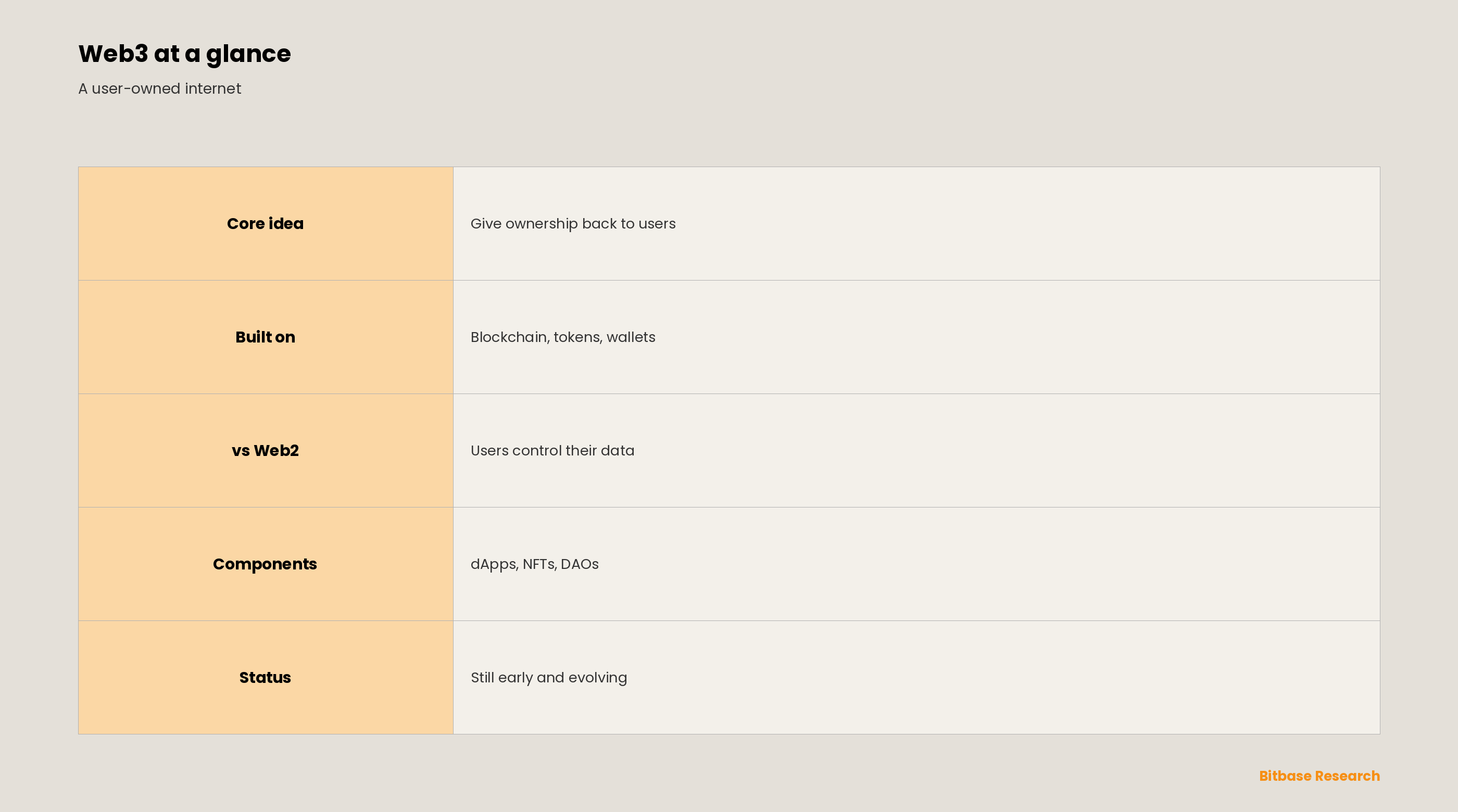
Web3 is a vision for a new form of the internet that blends decentralization, blockchain technology, tokenomics, and privacy-enhancing ideas [1]. In a Web3 design, data ownership shifts to users — you decide how and where your information is used.
Web3 at a glance
How it differs from Web2
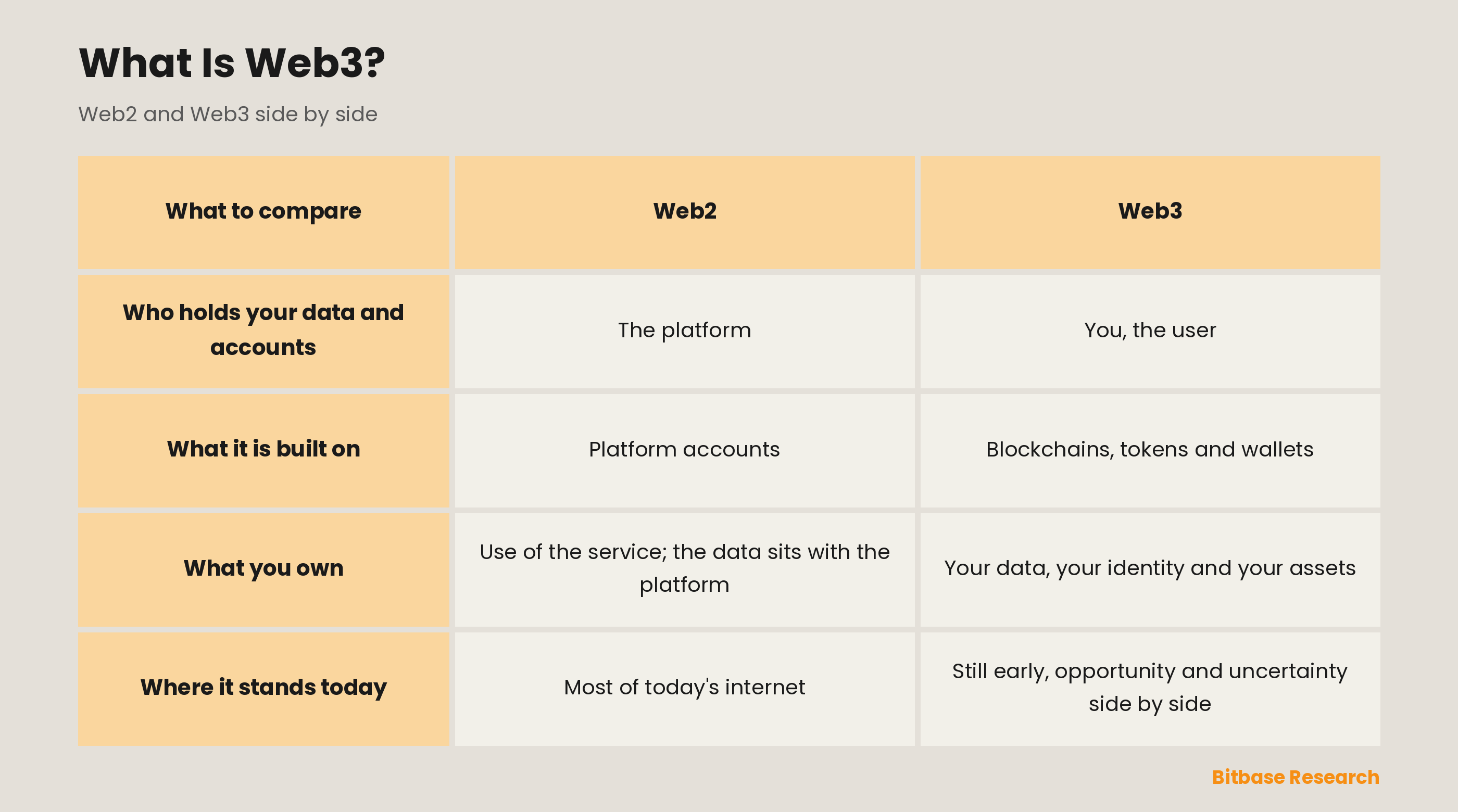
Most of today's internet is Web2: platforms hold your data and accounts. Web3 instead tries to use blockchains, tokens, and wallets to let users truly "own" their data, identity, and assets [2]. It is still early, with opportunity and uncertainty side by side.
Web2 and Web3 side by side
The Main Limits of Web3
Web3 has several notable limits: scalability, a user experience that is still hard work, dependence on centralized infrastructure, smart-contract risk, the question of how protocols are governed, and regulatory uncertainty.
The bottom line
Web3 is a blockchain-based vision of the internet that emphasizes user ownership, spanning dApps, NFTs, and DAOs. Understanding it helps you grasp crypto's long-term narrative. To keep learning the fundamentals, follow more from Bitbase Academy.
Frequently asked questions
Are Web3 and blockchain the same thing?
No. A blockchain is one of the technologies Web3 is built on, alongside crypto wallets, smart contracts and tokens. Web3 is the broader idea that those pieces together hand ownership of data, identity and assets back to users, and it is not a single technology in itself.
Are Web3 and crypto the same thing?
No. Cryptocurrencies and tokens are components that Web3 services use, while Web3 describes how the services themselves are designed. You can hold crypto without ever opening a Web3 application, and a Web3 application can deal with identity or data with no trading involved at all.
Is Web3 fully decentralized?
No. Web3 does not mean that every service is fully decentralized: many still depend on centralized infrastructure, and how protocols are governed remains an open question in itself. It is better read as a direction of travel than as a finished state.
Why do you need a crypto wallet in Web3?
A crypto wallet is both where the assets sit and how you sign in. Instead of an account held by a platform, the wallet holds the keys that prove the assets and the identity are yours, and it is what signs the actions an application asks for. That is the practical difference the Web2 and Web3 comparison above describes.
Related reading
Other Bitbase articles on this topic:
- Fiat vs Crypto: What's the Difference?
- Types of Cryptocurrency: A Simple Overview
Disclaimer: This article is educational content from Bitbase Academy, provided for information only. It does not constitute investment, trading, tax, or financial advice. Written as of June 2026; refer to the latest official information.
References
[1] Ethereum.org, "What is Web3 and why is it important?" ethereum.org
[2] McKinsey, "What is Web3 technology (and why is it important)?" mckinsey.com