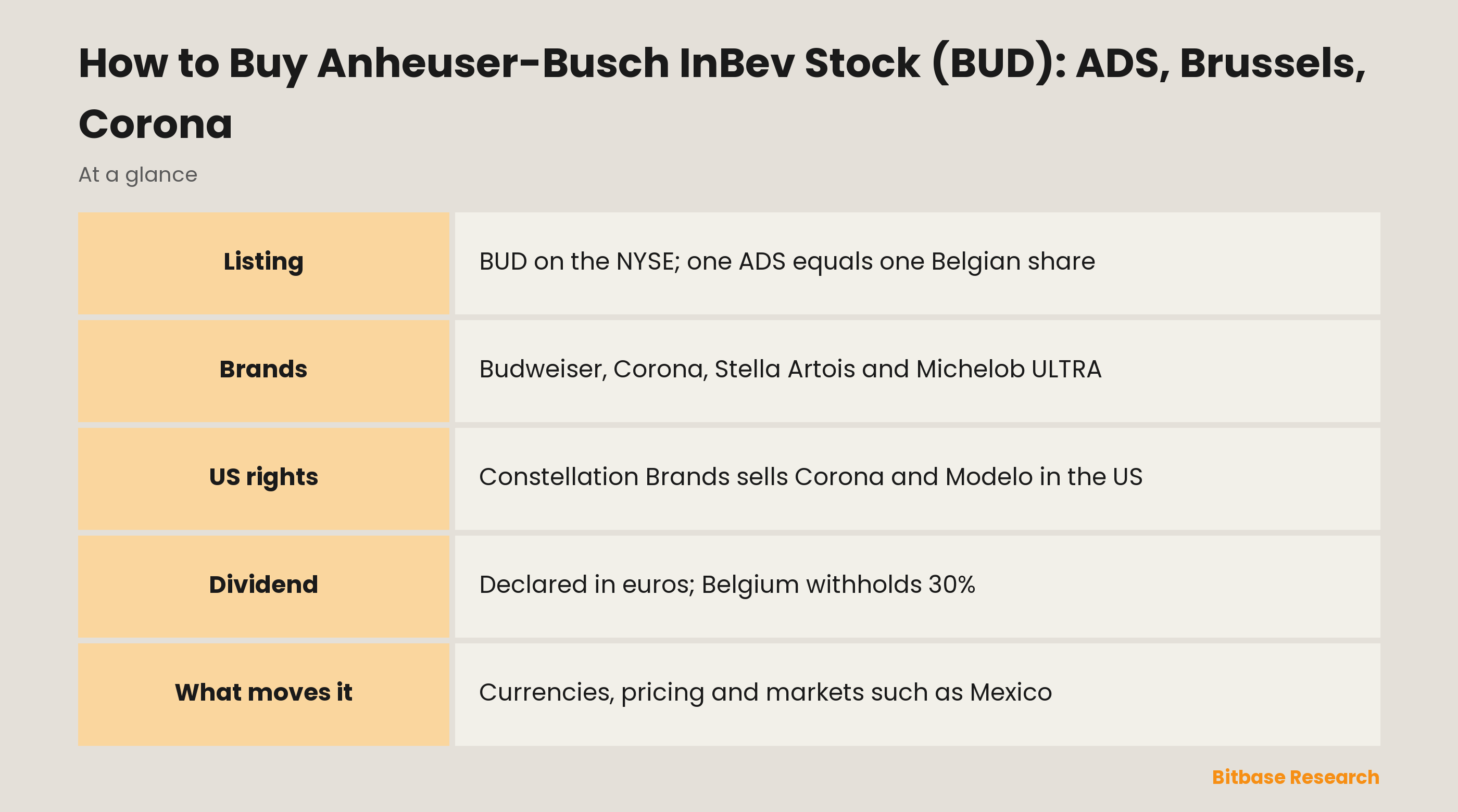
Its American depositary shares trade on the New York Stock Exchange as BUD, so any broker with NYSE access can buy Anheuser-Busch InBev stock for you; each ADS stands for one ordinary share of the Belgian company, whose primary listing is on Euronext Brussels. The brewer of Budweiser and Stella Artois earns 75% of its revenue through operating companies that keep their books in currencies other than the dollar, and the Corona on American shelves is not its beer to sell.
What Does Anheuser-Busch InBev Do?
AB InBev, as its filings shorten the name, sells "a portfolio of well over 400 beer and malt beverage brands," according to its annual report on Form 20-F, plus soft drinks, spirits-based drinks and energy drinks. The parent, Anheuser-Busch InBev SA/NV, is incorporated in Belgium and run from Leuven; Anheuser-Busch Companies of St. Louis is a wholly owned subsidiary.
Four brands are global: Budweiser, Corona, Stella Artois and Michelob ULTRA. Beck's, Hoegaarden, Leffe and Modelo travel across several countries, while names such as Bud Light, Brahma, Skol and Harbin anchor single markets. Budweiser is less American than its image: sales outside the United States made up over 80% of its volume in 2025. Drinks other than beer brought in 11% of revenue that year.
The group grew through deals. Interbrew, formed in 1987 by the merger of Belgium's two largest breweries, floated in Brussels in December 2000 and joined Brazil's Ambev in 2004 to create InBev, which combined with Anheuser-Busch in 2008 and took its current name. Grupo Modelo followed in 2013 and SABMiller, called SAB in the filings, in 2016.
How AB InBev Makes Money Across Five Regions
Revenue here means turnover minus excise taxes and discounts, reported in five regions:
| Region | Principal markets named in the 20-F | Share of 2025 revenue | Revenue change vs 2024, in US dollars |
|---|---|---|---|
| Middle Americas | Mexico, Colombia, Peru, Ecuador | 29.3% | +1.8% |
| North America | United States, Canada | 24.0% | −3.1% |
| South America | Brazil, Argentina | 20.2% | −3.8% |
| EMEA | Belgium, South Africa, Nigeria | 16.0% | +5.5% |
| Asia Pacific | China, South Korea | 9.6% | −8.1% |
The remaining 1.0% comes from export and holding companies. Citing Bernstein Research, the 20-F says AB InBev has the largest share of beer by volume in the United States, Mexico and Brazil. It also owned 87.22% of Budweiser APAC, listed in Hong Kong since 2019, at the end of 2025.
In 2025 volumes fell 2.5% and reported revenue slipped 0.8%, but excluding currency translation, Argentine hyperinflation effects, acquisitions and disposals, revenue rose 2.0%, and 4.4% per hectoliter, which the company credits to "disciplined revenue management choices and ongoing premiumization."
BUD Stock at a Glance
| Field | BUD |
|---|---|
| US listing | NYSE, ticker BUD, since 16 September 2009 |
| What BUD is | ADS, representing one ordinary share each |
| Other listings | Euronext Brussels (ABI, primary); Johannesburg (ANH); Mexico (ANB) |
| Depositary bank | The Bank of New York Mellon |
| Sector | Brewing, plus soft drinks and other beverages |
| Incorporation | Belgium; headquarters in Leuven |
| Fiscal year and reporting | Calendar year; IFRS, reported in US dollars |
| Dividend policy | At least 25% of profit attributable to equity holders, excluding exceptional items; declared in euros |
| Largest shareholder | Stichting Anheuser-Busch InBev, 33.99% of voting rights at 31 December 2025 |
| SEC filings | Form 20-F (annual) and Form 6-K (results and news) |
For the live quote and chart, see the Anheuser-Busch InBev stock page on Bitbase.
How to Buy Anheuser-Busch InBev Stock
The same company has four quotes: BUD in dollars, ABI in euros, ANH in rand and ANB in pesos. The New York route:
1. Choose a broker with NYSE access. Check who regulates it. The ordinary shares, priced in euros, require access to Euronext Brussels.
2. Open and verify the account. State your tax residence correctly; Belgian withholding relief depends on it.
3. Fund it. A currency conversion has its own cost, so check the rate you are given.
4. Find the right line. Bud is also an English word and a beer AB InBev sells in Europe, and the 20-F cover registers 21 note series on the NYSE whose symbols also begin with BUD. On the exchange a stock symbol is reserved for one security, but search boxes mix results: confirm the name Anheuser-Busch InBev SA/NV and the type, American depositary share.
5. Pick an order type. The SEC describes a market order as one "at the best available price" whose execution price "is not guaranteed," and a limit order as one "at a specific price or better" that "is not guaranteed to execute." The difference shows in how a market order fills.
6. Size the position. FINRA notes that some firms do not offer fractional shares, that on a fraction "you might not have shareholder voting rights," and that for now you "can't transfer fractional shares to another brokerage firm."
What the ADS changes. In the SEC's wording, an ADR is "a security that represents shares of non-U.S. companies that are held by a U.S. depositary bank outside the United States." For BUD that bank is BNY Mellon, and the 20-F says: "As an ADS holder, we will not treat you as one of our shareholders and you will not have shareholder rights." You vote through the depositary, its fees per ADS can come out of cash distributions, and payment lags: the final 2025 dividend was paid on Euronext on 11 May 2026 but to ADR holders on 5 June 2026.
Belgian withholding tax. Belgium withholds 30% of gross dividends on shares and ADSs, subject to treaty relief. For a qualifying US resident the treaty rate is 15%, but normally the full rate is withheld and the excess reclaimed later; others depend on their own country's treaty, and home taxes may apply. Because the dividend is declared in euros, its dollar value moves with the exchange rate.
Through a fund. SPY, State Street's S&P 500 fund, held no AB InBev shares in its 16 October 2026 holdings file; its international funds SPDW and CWI held the Brussels line, ABI.
What Moves BUD Stock
Currencies. AB InBev reports in dollars, but 75% of its 2025 revenue came from operating companies with other functional currencies, and it says "we cannot hedge against translational exposures." In the first half of 2026 revenue grew 5.7% organically and 11.5% as reported, "positively impacted by currency translation"; in 2025 the effect had run the other way.
Price and mix. The plan is more revenue per hectoliter from premium brands, no-alcohol beer and Beyond Beer drinks such as canned cocktails. In the second quarter of 2026 volumes rose 0.9% and revenue per hectoliter 4.2%.
A few large markets. Michelob ULTRA led US beer by volume in 2025, per Circana data cited in the 20-F, while the company's US sales to retailers fell 3.2%. Brazil's volumes dropped 4.1% in unseasonable weather, Mexico's held flat and China's fell 8.6%, then 9.7% in the second quarter of 2026.
Debt. The 20-F puts the optimal ratio of net debt to normalized EBITDA at around two times. The company reported 2.87 times at the end of 2025 and 2.86 times on 30 June 2026, so paying down debt competes with dividends and with the buyback announced on 30 October 2025.
The Risks in a BUD Holding
These 20-F risk factors bear most directly on BUD:
Developing markets. "We are exposed to developing market risks, including risks of devaluation, nationalization and inflation." In Russia, a December 2024 decree put the AB InBev Efes Russian operations under temporary management.
Reputation and health debate. "Damage to our reputation or the image and reputation of our brands can adversely affect our business," and "negative publicity and public advocacy regarding perceived or potential health risks, as well as changes in related government regulation, may harm our business."
A controlling shareholder. At the end of 2025 the Stichting held 33.99% of voting rights, or 39.50% with parties acting in concert, and "may use its significant interest to take actions not supported by our other shareholders." Altria (8.15% of voting shares in all) and BEVCO (4.97%) hold unlisted restricted shares, convertible one-for-one since October 2021, and sales of share blocks are among the price risks the 20-F lists.
The ADS and the dividend. Swings between the euro, the rand, the peso and the dollar "may increase the risk of holding our ADSs," and "deleveraging remains a priority and may restrict the amount of dividends we pay."
Checking BUD in the 20-F and 6-K Reports
Its CIK, the SEC's filer number, is 1668717. As a non-US issuer AB InBev files the annual Form 20-F and sends results and news on Form 6-K, and it posts the same documents in the results center of ab-inbev.com. An SEC investor bulletin points out that, "except for the annual report on Form 20-F, non-U.S. companies are generally only required to disclose what is required in their home country."
Results releases quote organic growth unless stated otherwise, so read them beside the reported figures. The 20-F's structured cover lists the ordinary shares next to BUD without a trading symbol: in New York, only the ADS trades. Quotes for other listed companies sit on the Bitbase stock pages.
Anheuser-Busch InBev Stock FAQ
Is BUD the same as AB InBev shares in Brussels?
Economically close, legally different. Each ADS represents one ordinary share held by the depositary, but you are not a shareholder under Belgian law. BUD trades in dollars and ABI in euros, and the 20-F warns that currency moves can open "temporary differences" between their values.
Does Anheuser-Busch InBev pay a dividend?
Yes. The policy is at least 25% of profit attributable to equity holders, excluding exceptional items. For 2025 the company paid an interim dividend in November 2025, and shareholders approved the final one on 29 April 2026.
Can I buy Anheuser-Busch InBev stock with crypto?
Not directly. BUD is bought through a broker and trades in dollars, so the crypto must first become ordinary money in the brokerage account. In many countries selling crypto can be a taxable event, which makes that sale a decision of its own.
Does AB InBev sell Corona and Modelo in the United States?
No. When Grupo Modelo sold its US business in 2013, Constellation Brands received "the exclusive and perpetual right to market and sell Corona beer and certain other Grupo Modelo beer brands" in the 50 states, the District of Columbia and Guam; its license covers Modelo Especial and Pacifico too. Outside those territories, Corona is one of AB InBev's global brands.
How is Ambev related to AB InBev?
AB InBev controls it, with 61.73% at the end of 2025. Ambev has its own listings in São Paulo and on the NYSE, so its shares are a separate investment from BUD, even though its results flow into AB InBev's.
Conclusion
An NYSE order for BUD gets you a depositary share standing for one Belgian ordinary share, whose euro dividends pass through Belgian withholding before they arrive in dollars. The exposure you get is to a brewer leaning on Mexico, the United States and Brazil, and on currencies it cannot hedge. Check the newest 20-F and 6-K filings first, then settle how large a place a single brewer deserves in what you hold.
Related reading
Other Bitbase articles on this topic:
- How to Buy ATT Stock (T): Dividend, Fiber Push and Mexico Sale
- How to Buy Charles Schwab Stock (SCHW): Rates, Cash, Crypto
- How to Buy Danaher Stock (DHR): Bioprocessing, Masimo, Spin-offs
- How to Buy John Deere Stock (DE): Tractors, Loans, Farm Cycle
- How to Buy Philip Morris Stock (PM): Dividend, IQOS and ZYN
Disclaimer: This article is educational content from Bitbase Academy, provided for information only. It explains what a company or fund does and how the instruments referenced here differ from one another; it does not constitute investment, trading, tax, or financial advice, and it is neither a recommendation nor an endorsement of any security, token, or trading strategy. A tokenized stock is issued by a third party and is designed to give economic exposure to an underlying asset: it is not a share, it carries no shareholder rights, and it depends on the issuer's structure, eligibility rules, and redemption terms, which the issuer can change. Perpetual futures are leveraged derivatives that hold no underlying asset and can be liquidated, and trading hours, product availability, and eligibility differ by instrument and by jurisdiction and can change at any time. Written as of October 2026; verify everything yourself through company filings, the issuer's own documentation, and the product pages of the venue you trade on.
References
[1] Anheuser-Busch InBev SA/NV Form 20-F, fiscal 2025: business, segment revenue, risk factors, shareholders, taxation and ADS fees (SEC EDGAR) www.sec.gov
[2] Form 20-F fiscal 2025, structured cover (R1.htm): ADS ticker BUD on the NYSE, ordinary shares without a trading symbol, note series (SEC EDGAR) www.sec.gov
[3] AB InBev second quarter 2026 results, 30 July 2026: organic and reported revenue, volumes, net debt to EBITDA (Form 6-K, Exhibit 99.1) www.sec.gov
[4] AB InBev press release, 29 April 2026: shareholders' meeting approves the 2025 dividend; payment dates by market (Form 6-K, Exhibit 99.1) www.sec.gov
[5] SEC Investor Bulletin: American Depositary Receipts www.sec.gov
[6] SEC Investor Bulletin: Trading Basics, the different ways to buy and sell stock www.sec.gov
[7] FINRA Investor Insights: Investing in Fractional Shares, 26 June 2025 www.finra.org
[8] State Street: SPDR S&P 500 ETF Trust (SPY), daily holdings as of 16 October 2026 www.ssga.com
[9] State Street: SPDR Portfolio Developed World ex-US ETF (SPDW), daily holdings as of 16 October 2026 www.ssga.com
[10] State Street: SPDR MSCI ACWI ex-US ETF (CWI), daily holdings as of 16 October 2026 www.ssga.com