
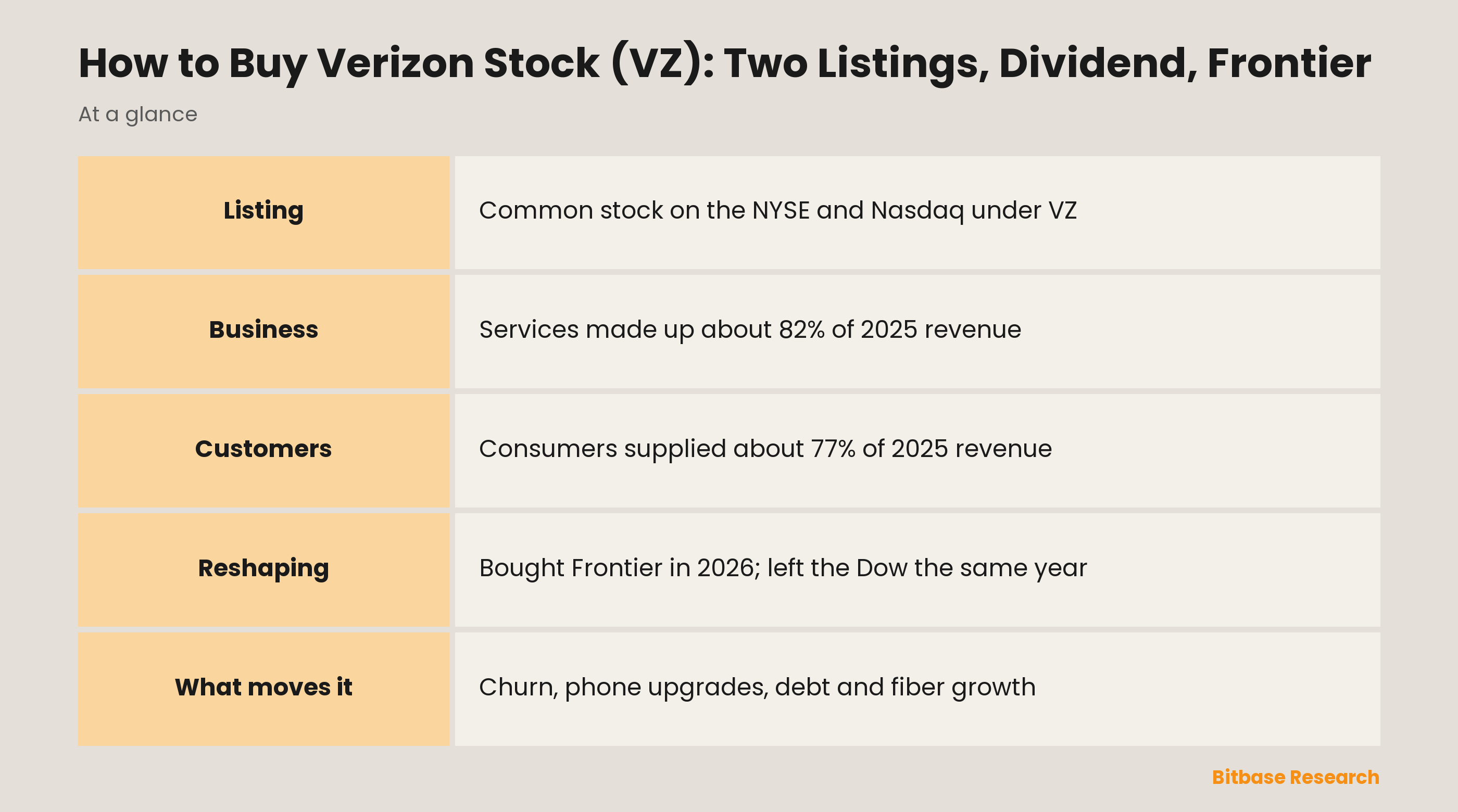
On both the New York Stock Exchange and Nasdaq, Verizon's common stock trades under one ticker, VZ, so a brokerage account that offers US equities is enough to buy it. The company behind the ticker lives mostly on monthly bills: about 82% of its 2025 revenue came from services rather than device sales, and consumers supplied about 77%. In January 2026 it bought Frontier Communications, nearly ten years after selling Frontier its landline business in three states. This guide covers how Verizon earns its money, how to place the order, why it left the Dow in 2026, and which risks its own filings put first.
What Does Verizon Do?
Verizon sells connectivity: mobile service, home and business internet, and the networks that carry them. The listed parent is a holding company that operates through subsidiaries, and its history page dates it precisely: "Verizon Communications was created on June 30, 2000 by Bell Atlantic Corp. and GTE Corp., in one of the largest mergers in U.S. business history." Its legal home is Delaware; its head office is in New York.
The business reports two segments. Verizon Consumer Group sells wireless service under the Verizon family of brands, both postpaid, billed a month in advance, and prepaid, paid upfront without a credit check; postpaid made up about 83% of its wireless retail connections at the end of 2025. It also sells home internet over Fios fiber, an older copper network and fixed wireless access (FWA), which delivers broadband through the 4G and 5G networks instead of a cable.
Verizon Business Group serves companies and public bodies through three customer groups: Enterprise and Public Sector for large organisations and government, Business Markets and Other for small and medium businesses, and Wholesale for other carriers. A few large telecom companies generate part of the wholesale revenue, and, as the 10-K notes, "most of which compete directly with us."
Both segments run on licensed spectrum, including the 3.7 GHz C-Band and millimetre-wave bands. FCC wireless licences generally last ten years and must be renewed.
The company has redrawn its borders several times. In February 2014 it bought Vodafone's indirect 45% interest in Verizon Wireless. In April 2016 it sold its local landline business in California, Florida and Texas, Fios customers included, to Frontier Communications. On 20 January 2026 it acquired Frontier itself, extending its fiber footprint to 31 states and Washington, D.C., and ten days later it closed the purchase of Starry, a fixed wireless provider for apartment buildings. In June 2026 it agreed to put its international wireline business into a joint venture with BT Group, each side owning 50%; closing still needed regulatory approvals when the July quarterly report was filed.
How Verizon Makes Money
In 2025, service revenues and other made up about 82% of Verizon's revenue and wireless equipment sales about 18%. Wireless service alone, the charge for mobile plans across both segments, came to about 61%. Total revenue grew 2.5%, with Consumer up 3.8% and Business down 1.6%:
| Revenue line | Segment | Share of 2025 revenue | Change from 2024 |
|---|---|---|---|
| Service (wireless plans, Fios, FWA) | Consumer | 58.6% | +1.8% |
| Wireless equipment | Consumer | 15.8% | +11.1% |
| Other | Consumer | 3.0% | +7.0% |
| Enterprise and Public Sector | Business | 9.8% | −4.8% |
| Business Markets and Other | Business | 9.8% | +3.7% |
| Wholesale | Business | 1.4% | −11.7% |
| Corporate and other | Outside the segments | 1.9% | +1.3% |
The percentages are our arithmetic on the dollar figures in the 10-K, to one decimal place. Intersegment eliminations take away about 0.2%, so the rows add up to slightly more than 100%.
Consumer service is mostly mobile plans. Wireless service in that segment grew 2.1%, which the 10-K credits to "higher adoption of perks and premium MyPlan offerings, pricing actions, and a 26% increase in our FWA subscriber base." Fios revenue rose only 0.3%, and Fios video connections, the traditional pay-TV product, fell 9.1%; the 10-K expects the market to keep shifting "from traditional linear video to OTT offerings."
Equipment is the part that swings. Consumer equipment revenue rose 11.1%, but the cost of wireless equipment rose 11.0%, driven by a 12% rise in upgrades and pricier handsets. That cost was larger than equipment revenue on the income statement, so device sales lift the top line more than profit.
Business revenue has fallen two years in a row. Enterprise and Public Sector dropped 4.8%, which the 10-K ties to declining networking, data and voice services and to "pressure in Public Sector in part from government efficiency efforts." Business Markets and Other grew 3.7%, helped by pricing actions and more FWA subscribers.
The base is domestic and spread out: no single customer accounted for more than 10% of revenue in 2023, 2024 or 2025, and international revenue was not significant. From 2026 the mix shifts, though only a little so far: the second-quarter 10-Q put revenue from the Frontier and Starry purchases at less than 5% of the first-half total.
VZ Stock at a Glance
| Fact | VZ |
|---|---|
| Exchanges | New York Stock Exchange (principal market) and Nasdaq Global Select Market |
| Ticker | VZ, the same symbol on both exchanges |
| Share class | One class of common stock, listed on both exchanges |
| Listed debt | 33 series of Verizon notes on the NYSE, with symbols such as VZ 26B |
| Sector | Telecommunications: wireless, broadband and business networks |
| Formed | 30 June 2000, from Bell Atlantic and GTE |
| Incorporated | Delaware |
| Head office | New York City |
| Index membership | S&P 500; no longer in the Dow Jones Industrial Average |
| Financial year | January to December |
| Dividends | Paid quarterly; the 2025 raise was the 19th annual increase in a row |
| SEC filer number | CIK 732712 |
The table leaves out anything that moves daily. Live price, market capitalisation and dividend yield are on the Verizon stock page on Bitbase.
Two listings do not mean two kinds of share, and the Nasdaq listing does not put Verizon in the Nasdaq-100. Invesco QQQ's portfolio report for 30 June 2026 does not include it, because a Nasdaq listing and the Nasdaq-100 index are different things.
How to Buy Verizon Stock
Verizon is a US company with US-listed common stock, so no depositary receipt sits between you and the share. At a broker, the sequence is:
1. Find a broker with US market access. Either exchange gets you the same share, so judge the broker: which entity holds your account, who regulates it, what US trades cost.
2. Open the account and settle your tax status. Non-US individuals normally file IRS Form W-8BEN, the certificate a broker needs before it can apply a treaty rate to US dividends.
3. Fund it. If your money is not in dollars, look at the currency spread the broker charges, not only the commission.
4. Pick the right line. Search VZ and make sure the name shown is Verizon Communications common stock. Entries such as VZ 26B or VZ 31A are Verizon notes, which are bonds.
5. Choose the order type. In the SEC's Investor.gov definitions, a market order is certain to execute but not at a guaranteed price, while a limit order trades "at a specific price or better."
6. Decide the size. Some brokers sell fractions of a share by cash amount; check which order types yours accepts for fractions and whether a fraction carries a vote.
7. File the paperwork. Each trade confirmation and statement records your cost basis and the dividends paid to you.
Outside the United States, tax comes off Verizon dividends before you receive them. Under IRS rules, most US-source income paid to a foreign person is taxed at 30%, and a treaty between the US and your country can cut that rate or remove it. Because Verizon pays quarterly, the withholding shows up four times a year, and your own country may then tax the same dividend.
Index funds are the indirect route. Funds that replicate the S&P 500 own Verizon as one constituent among hundreds; State Street's SPY listed it in its holdings file for 16 October 2026. The same manager's Dow fund, DIA, no longer holds it.
What Moves VZ Stock
The subscriber scoreboard. Each quarter Verizon reports wireless net additions, churn and revenue per account, which show whether it is gaining or losing customers against AT&T, T-Mobile US and the cable operators, Comcast and Charter among them, that resell wireless service. The 10-K names all four and warns that rivals "commonly offer aggressive pricing, promotions, premium content options and other incentives." In 2025 Consumer postpaid churn rose to 1.15% from 1.06%, even as service revenue grew.
Upgrade cycles and subsidies. Equipment revenue follows how often customers replace phones and how much carriers spend to make them. In its July 2026 earnings release Verizon said a fall in second-quarter equipment revenue "resulted primarily from significantly lower upgrade volumes, as the average time customers keep their mobile devices continues to increase, and the company's strategic decision to reduce spending on device subsidies." Since devices cost Verizon more than they brought in during 2025, falling equipment revenue is not the same as falling profit.
A turnaround under a new chief executive. Dan Schulman, a Verizon director since 2018, became CEO in October 2025. A month later the company announced a workforce reduction eliminating more than 13,000 positions, with over 80% of those affected due to leave in December 2025, and by mid-2026 it had introduced new Simplicity plans and Verizon One bundles of mobile and home internet.
Debt and the cost of borrowing. The risk factor is blunt: "Verizon has a significant amount of debt, which could increase further if we incur additional debt in the future and do not retire existing debt." Verizon issued notes in 2025 to pay for Frontier and assumed Frontier's debt, repaying most of that assumed principal in the first half of 2026. The 10-K adds that debt brings "increased interest rate risk" when rates are variable or old debt is refinanced higher.
Fiber and fixed wireless. Broadband is where Verizon adds connections. FWA reached about 5.7 million connections at the end of 2025, and Frontier carried the fiber footprint well beyond Verizon's old territory. How fast those new areas take fiber now feeds the mobility and broadband figures.
Capital returns. On 30 January 2026 the board declared a quarterly dividend above the prior annual rate and authorised a new share repurchase program; accelerated repurchases were completed in March and June 2026.
Risks to Weigh Before Buying VZ
Of the many risk headings in the 10-K, these bear most directly on a VZ share:
Competition. "We face significant competition that may negatively affect our operating results." The company also expects wireless customer growth "to continue to moderate over time," which means more competition for the same customers.
Network failures. "System failures and disruptions to our networks and operations could prevent us from providing reliable service to customers and adversely affect our business." The filing's own example: in early 2026 Verizon "experienced an outage resulting in a widespread disruption of service to our customers." Cyberattacks are a separate heading.
Lead-sheathed cables. "Allegations related to lead sheathed copper cables in our copper network infrastructure could expose us to regulatory scrutiny, litigation, penalties, removal and compliance costs, operational impact or reputational damage." Media reports have already led to government investigations, regulatory inquiries and litigation.
Labour. About 27% of the workforce was represented by the Communications Workers of America or the International Brotherhood of Electrical Workers at the end of 2025; in March 2026 members ratified a four-year extension of the main East agreements, to 3 August 2030.
The dividend itself. "There can be no assurance that our current or future share repurchase programs will be fully consummated or that we will continue to increase our dividend."
Two more risks have nothing to do with telecoms. Owning one stock concentrates your money in one company's results, however steady its bills look. And for an investor whose home currency is not the dollar, exchange-rate moves change both the value of the shares and every dividend.
How to Research VZ Yourself
Everything Verizon reports to the SEC sits under CIK 732712 on EDGAR. Annual reports are 10-Ks, quarterly reports 10-Qs, and material news in between arrives as an 8-K: earnings releases, the Frontier closing, the January 2026 dividend and buyback announcement.
Inside the 10-K, the segment tables give connections, churn and revenue per account, and the shareholder return graph shows the benchmarks Verizon picks for itself: the S&P 500 and the S&P 500 Communication Services Index.
Two checks save confusion. The structured cover of the 2025 report, R1.htm, lists the common stock twice, once per exchange, beside the 33 note series; only the plain VZ line is a share. And from 2026 segment revenue is grouped into mobility and broadband service, wireless equipment and other, with the international wireline business moved into Corporate and other from the second quarter, so compare like with like. Bitbase also keeps stock pages for other US companies.
Verizon Stock FAQ
Does Verizon pay a dividend?
Yes, a cash dividend four times a year. The 10-K calls the 2025 increase the "nineteenth consecutive year" of a higher quarterly payout, and on 30 January 2026 the board declared a quarterly dividend above the prior annual rate. Future payments "are subject to declaration by the Company's Board of Directors," and the amount and record date of each one are published when the board acts.
Can I buy Verizon stock with crypto?
Not in one step. Verizon shares trade in US dollars through brokers, so the route is to sell the crypto, move the cash to a brokerage account and then place the order. In some tax systems selling crypto is a taxable event on its own. The two assets are also different things: the share is a registered stake in the company, with dividend and voting rights.
Is VZ listed on the NYSE or Nasdaq?
Both. The 10-K cover registers the common stock on the New York Stock Exchange and on the Nasdaq Global Select Market, each under VZ, and names the NYSE as the principal market. Either venue gives you the same share.
Is Verizon in the Dow Jones Industrial Average?
Not any more. State Street's DIA, which holds the 30 Dow stocks, listed Verizon in its portfolio report for 31 January 2026 but not in the one for 31 July 2026, where Alphabet appears instead. Verizon remains in the S&P 500; leaving the Dow changes which funds hold it, not what a share gives you.
Did Verizon buy Frontier?
Yes. The agreement was signed on 4 September 2024 and closed on 20 January 2026, making Frontier a wholly owned subsidiary. Nearly ten years earlier, in 2016, Verizon had sold Frontier its landlines in California, Florida and Texas.
Conclusion
The mechanics of a VZ purchase take minutes: a broker that trades US stocks, the common stock rather than a note, and a market or limit order. Understanding the share takes longer, because it now holds a mostly domestic, mostly subscription business with significant debt, newly enlarged by Frontier and run by a new chief executive. Read the latest 10-K and quarterly reports, especially churn, equipment revenue and debt, before deciding how much of a portfolio belongs in one telecom stock.
Related reading
Other Bitbase articles on this topic:
- How to Buy John Deere Stock (DE): Tractors, Loans, Farm Cycle
- How to Buy Morgan Stanley Stock (MS): Wealth, Deals, Stress Test
- How to Buy Novartis Stock (NVS): ADR, Swiss Tax, Entresto
- How to Buy Qualcomm Stock (QCOM): Chips, Royalties and Perps
- How to Buy T-Mobile Stock (TMUS): Dividend and the Telekom Stake
Disclaimer: This article is educational content from Bitbase Academy, provided for information only. It explains what a company or fund does and how the instruments referenced here differ from one another; it does not constitute investment, trading, tax, or financial advice, and it is neither a recommendation nor an endorsement of any security, token, or trading strategy. A tokenized stock is issued by a third party and is designed to give economic exposure to an underlying asset: it is not a share, it carries no shareholder rights, and it depends on the issuer's structure, eligibility rules, and redemption terms, which the issuer can change. Perpetual futures are leveraged derivatives that hold no underlying asset and can be liquidated, and trading hours, product availability, and eligibility differ by instrument and by jurisdiction and can change at any time. Written as of October 2026; verify everything yourself through company filings, the issuer's own documentation, and the product pages of the venue you trade on.
References
[1] Verizon Form 10-K for 2025: business, segment revenue, risk factors and market for the stock (SEC EDGAR) www.sec.gov
[2] Verizon 10-K for 2025, structured cover page (R1): registered securities, symbols and exchanges www.sec.gov
[3] Verizon Form 10-Q for the quarter ended 30 June 2026: Frontier, BT joint venture, labour agreements (SEC EDGAR) www.sec.gov
[4] Verizon Form 8-K, 30 January 2026: quarterly dividend and new share repurchase program (SEC EDGAR) www.sec.gov
[5] Verizon Form 8-K, 20 November 2025: workforce reduction (SEC EDGAR) www.sec.gov
[6] Verizon second-quarter 2026 results release, 24 July 2026 (Form 8-K, Exhibit 99) www.sec.gov
[7] Verizon 2016 annual report (10-K, Exhibit 13): Vodafone stake purchase in 2014 and landline sale to Frontier in 2016 www.sec.gov
[8] Verizon: history and timeline www.verizon.com
[9] State Street: SPY daily holdings, 16 October 2026 www.ssga.com
[10] SPDR Dow Jones Industrial Average ETF Trust (DIA): portfolio report as of 31 January 2026 (Form N-PORT, SEC EDGAR) www.sec.gov
[11] SPDR Dow Jones Industrial Average ETF Trust (DIA): portfolio report as of 31 July 2026 (Form N-PORT, SEC EDGAR) www.sec.gov
[12] Invesco QQQ Trust: portfolio report as of 30 June 2026 (Form N-PORT, SEC EDGAR) www.sec.gov
[13] Investor.gov (SEC): Types of Orders www.investor.gov
[14] IRS: NRA Withholding www.irs.gov